
Nabby's Point
ca. 1913
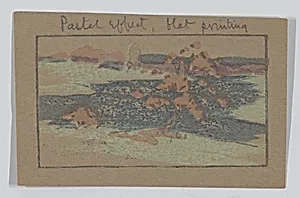
Medium
Color woodcut; trial proof on brown paper
Dimensions
Image: 2 3/16 × 3 3/4 in. (5.6 × 9.5 cm) Sheet: 2 13/16 × 4 1/2 in. (7.1 × 11.4 cm)
Classification
Woodcut, print
Culture
American
Department
The American Wing
Museum
Metropolitan Museum of Art, New York, NY
Credit
Gift of the Dowd-Gallogly Family and Allan E. Dowd, 2016
Accession Number
2016.406.5
Rights
Public Domain
Tags
Art Historical Context
Arthur Wesley Dow’s “Nabby’s Point” (ca. 1913) is a small yet luminous color woodcut that captures the artist’s lifelong fascination with simplified form and harmonious color. Measuring just over two by three inches, the intimate trial proof printed on brown paper reveals Dow’s experimental approach to the medium. He drew on Japanese ukiyo-e techniques—carving separate blocks for each hue—to distill a coastal view into flat planes of color and rhythmic line, transforming a specific New England locale into an abstract meditation on light and space. Dow, an influential teacher and theorist, championed the idea that art should be built from the basic elements of line, tone, and color rather than mere representation. This tiny print embodies that philosophy, reflecting his pivotal role in bridging late nineteenth-century American landscape traditions with emerging modernist abstraction. Its presence in the Metropolitan Museum’s American Wing underscores Dow’s lasting impact on generations of artists who adopted his compositional principles. Acquired through the generosity of the Dowd-Gallogly family, the work invites viewers to appreciate how even the most modest print can encapsulate a transformative moment in American art.
About the Artist
Arthur Wesley Dow · 1857–1922
Arthur Wesley Dow (1857–1922) was an American artist, printmaker, and educator whose ideas about composition and design exerted an outsized influence on American modernism, reaching well beyond anything his own paintings and prints might have achieved on their own. Born in Ipswich, Massachusetts, he studied in Boston and then in Paris at the Académie Julian, where he absorbed the academic training...