
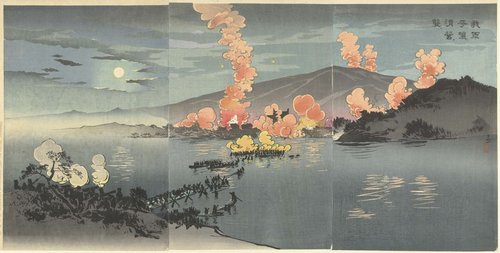
Nachtelijke aanval van onze gewapende troepen op het Chinese kamp te Pyongyang.
1894-10
Medium
color woodcut
Dimensions
715; 356
Rights
Public Domain
About this artwork
beeld: hoogte 356 mm x breedte 715 mm
Art Historical Context
In the dim glow of moonlight and flickering torches, Kobayashi Kiyochika's *Nachtelijke aanval van onze gewapende troepen het Chinese kamp te Pyongyang* (Night Attack by Our Forces on the Chinese Camp Pyongyang) captures a pivotal moment from the First Sino-Japanese War. Created in October 1894 as a color woodcut triptych—measuring 356 mm high by 715 mm wide—this vividly depicts Japanese troops storming a Chinese encampment, blending dramatic action with the fog of night battle. Kiyochika, a leading Meiji-era ukiyo-e artist, mastered this medium to produce *senso-e* (war prints), affordable and timely woodblock images that served as visual newspapers for the public. The artwork's historical significance lies in its documentation of the Battle of Pyongyang in late September 1894, a decisive Japanese victory that shifted momentum in the war over Korean influence. These prints fueled national pride, with "our" forces portrayed heroically against a chaotic enemy camp. Kiyochika's technique shines in his innovative use of shadow and light—achieved through subtle *benizuri-e* coloring and precise carving—evoking tension and movement without relying on Western perspective. As a cultural artifact, this woodcut reflects Japan's rapid modernization and printmaking prowess, bridging traditional ukiyo-e with contemporary events. Visitors, imagine holding such a print fresh from the blocks, its bold lines and vibrant hues bringing history alive!
About the Artist
Kobayashi Kiyochika · 1847–1915
Japanese, 1847–1915