
Nail Violin
Unknown Artist
early 19th century
Medium
Wood, metal
Dimensions
Total H. 13.5 cm., H. of wood arc and soundboard 4.7 cm., Diamter 23.5 cm.
Classification
Idiophone-Friction
Culture
German
Department
Musical Instruments
Museum
Metropolitan Museum of Art, New York, NY
Credit
The Crosby Brown Collection of Musical Instruments, 1889
Accession Number
89.4.954
Rights
Public Domain
Art Historical Context
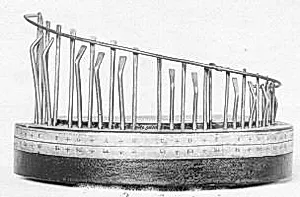
Nestled in the Metropolitan Museum of Art's Crosby Brown Collection of Musical Instruments this early 19th *Nail Violin* exemplifies a quirky yet ingenious German folk instrument from the Romantic era. Crafted from wood and metal, it a compact design: a total height of 13.5 cm, with a wooden arc and soundboard rising 4.7 cm and a diameter of 235 cm. As an idiophone-friction, it produces ethereal, haunting tones not by striking or blowing, but by rubbing its metal elements—likely nails embedded in the wooden frame—with a moistened finger or rosined glove, creating shimmering overtones reminiscent of a glass armonica. This rare artifact highlights the inventive spirit of German luthiers during a time when experimental instruments flourished alongside the rise of virtuoso performers and salons. Friction idiophones like the nail violin captivated audiences with their otherworldly sounds, bridging folk traditions and classical music experimentation. Though the artist remains unknown, the meticulous woodworking and precise metalwork underscore the craftsmanship of regional artisans, who transformed humble materials into objects of sonic art. Today, it invites visitors to ponder the blurred lines between music, sculpture, and performance, offering a tangible glimpse into 19th-century sound innovation. (198 words)