
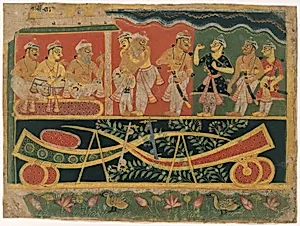
Nanda and Vasudeva: Page from a Dispersed Bhagavata Purana (Ancient Stories of Lord Vishnu)
ca. 1520–30
Medium
Ink and opaque watercolor on paper
Dimensions
Sheet: 7 in. × 9 3/8 in. (17.8 × 23.8 cm)
Classification
Paintings
Culture & Period
India (Delhi-Agra area) · Early Rajput-Chaurapanchasika style
Department
Asian Art
Museum
Metropolitan Museum of Art, New York, NY
Credit
Purchase, Anonymous Gift, 1982
Accession Number
1982.209
Rights
Public Domain
Tags
Art Historical Context
This luminous page comes from a now-dispersed Bhagavata Purana, the beloved Sanskrit text recounting the life of Krishna, an incarnation of Vishnu. Created around 1520–30 in the Delhi-Agra region, it belongs to the early Rajput-Chaurapanchasika style, one of the earliest flourishing traditions of Hindu court painting in northern India. The scene depicts Nanda and Vasudeva, key figures in Krishna’s story, and captures the intimate, narrative spirit that made such manuscripts treasured both as devotional objects and as works of art. Executed in ink and opaque watercolor on paper, the painting employs the bold outlines, vibrant mineral pigments, and flattened, expressive figures typical of the Chaurapanchasika manner. Small details—wagons and ducks among the figures—add lively touches of everyday life to the sacred narrative, reflecting the style’s characteristic blend of spiritual drama and affectionate observation of the natural world. As part of a once-larger manuscript, this leaf would have been turned during readings or temple rituals, allowing devotees to visualize the ancient stories. Today it offers modern viewers a rare glimpse into the artistic and devotional culture of early sixteenth-century India, where painting served as both storytelling and worship.