
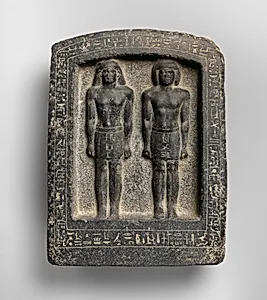
Naos stela with Pa-inmu and his father It, son of Pedise
Unknown Artist
664–610 B.C.
Medium
Basalt
Dimensions
H. 39.5 × W. 30.3 × D. 10 cm, 26.5 kg (15 9/16 × 11 15/16 × 3 15/16 in., 58.4 lb.)
Classification
Stela, Naos
Period
Late Period, Saite
Department
Egyptian Art
Museum
Metropolitan Museum of Art, New York, NY
Credit
Purchase, Fletcher Fund and The Guide Foundation Inc. Gift, 1966
Accession Number
66.99.67
Rights
Public Domain
Tags
Art Historical Context
This striking basalt naos stela from Egypt's Late Period (664–610 B.C.), the Saite Dynasty 26, honors Pa-inmu and his father, son of Pedise. Carved in the shape of a miniature shrine—a naos—this memorial slab stands about 40 cm tall and weighs over 25 kg, exemplifying the durable stone preferred for enduring funerary monuments. The Met's Egyptian Art collection acquired it in 1966 through the Fletcher Fund and The Guide Foundation Inc. Gift. The stela features incised figures of the two men, rendered in the refined, archaizing style characteristic of Saite art, which revived the elegance of Old Kingdom sculpture. Accompanying hieroglyphs likely invoke prayers or record their names and titles, a common practice to ensure eternal remembrance and offerings in the afterlife. Basalt's dark polish enhances the crisp lines of the carvings, making inscriptions and profiles pop against the stone. Culturally, such stelai served as personal altars in tombs or temples, bridging the living and divine realms. This piece reflects the Saite era's cultural renaissance, blending piety with artistic precision, inviting visitors to ponder ancient Egyptian devotion to family legacy and immortality.