
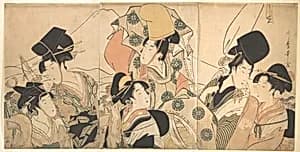
Narihira's Journey to the East
ca. 1797
Medium
Triptych of woodblock prints; ink and color on paper
Dimensions
Overall: 15 1/8 x 30 in. (38.4 x 76.2 cm)
Classification
Prints
Culture & Period
Japan · Edo period (1615–1868)
Department
Asian Art
Museum
Metropolitan Museum of Art, New York, NY
Credit
Gift of Estate of Samuel Isham, 1914
Accession Number
JP984
Rights
Public Domain
Tags
Art Historical Context
Step into the vibrant world of Edo-period Japan with Kitagawa Utamaro's *Narihira's to the East* (ca. 1797), a stunning triptych of woodblock prints in ink and color on paper. masterpiece, measuring 15 1/8 x 30 inches, captures a scene from the life of the legendary poet Ariwara no Narihira, drawn from the classic *Tales of Ise*. Utamaro, a leading figure in the ukiyo-e ("pictures of the floating world") movement, masterfully depicts elegant women accompanying Narihira on his eastward journey, their graceful poses evoking the fleeting beauty and romance of Heian-era tales amid everyday Edo life. Utamaro's genius shines in his bijin-ga style—portraits of beautiful women—rendered with exquisite detail through the collaborative woodblock process. Artisans carved intricate blocks for each color layer, allowing precise gradients and textures that bring kimono fabrics and expressive faces to life. Produced during Japan's prosperous Edo period (1615–1868), such prints were affordable luxuries, popular among urban merchants and reflecting a cultural obsession with fashion, theater, and literature. Housed in the Metropolitan Museum of Art's Asian Art Department, this gift from the Estate of Samuel Isham in 1914 highlights Utamaro's enduring influence on global art, from Japanese print culture to inspiring Impressionists like Monet. A window into 18th-century Japan's refined aesthetics, it invites visitors to ponder the timeless allure of poetry, travel, and feminine poise.
About the Artist
Kitagawa Utamaro · 1753–1806
Kitagawa Utamaro (c. 1753-1806) was one of the most celebrated masters of ukiyo-e woodblock printing, revolutionizing the art of bijin-ga (pictures of beautiful women) during Japan's Edo period. Born Kitagawa Ichitaro, his early life remains shrouded in mystery, with conflicting accounts placing his birth in Kyoto, Osaka, Yoshiwara in Edo (modern Tokyo), or Kawagoe in Musashi Province. Under the t...