
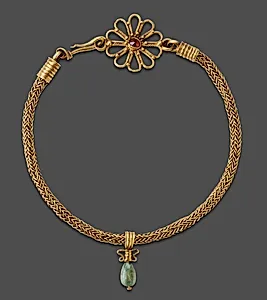
Necklace with Pendant
2nd-3rd century
Medium
Gold, garnet, and emerald
Dimensions
L. 35.6 cm (14 in.) (with clasp); pendant: h. 3.1 cm (1 1/4 in.)
Classification
pendant (jewelry)
Department
Arts of Greece, Rome, and Byzantium
Museum
Art Institute of Chicago
Accession Number
807
Rights
Public Domain
About this artwork
For both men and women in the Roman world, jewelry functioned as a visible sign of wealth, social standing, and gender. Artists of the time created some works in accord with earlier Hellenistic and Etruscan preferences for the extravagant and conspicuous use of gold. Over time, imperial expansion increased Romans’ access to a variety of valuable materials, leading to a distinctly Roman taste for jewelry incorporating color—typically in the form of gemstones or glass, as seen in this necklace.
Art Historical Context
This exquisite Necklace with Pendant, crafted by ancient Roman artisans in the nd-3rd century, exemplifies the empire's mastery of luxury jewelry. Fashioned from shimmering gold adorned with vibrant garnets and emeralds, the necklace measures an impressive 35.6 (14 in.) long with its clasp, while the pendant stands just 3.1 cm (1 1/4 in.) high. Such pieces were reserved for the elite, symbolizing wealth,, and divine favor in a society where personal adornment reflected social standing. Roman jewelers employed sophisticated techniques like granulation and filigree to create intricate designs, often drawing from Hellenistic influences and Eastern trade routes that supplied precious gems like garnet from India and emeralds from Egypt. Garnets, with their deep red hue evoking blood and passion, and emeralds symbolizing fertility and rebirth, held cultural significance in Roman mythology and daily life. Worn at banquets or religious ceremonies, this necklace would have caught the light, dazzling onlookers. Housed in the Art Institute of Chicago's Department of Arts of Greece, Rome, and Byzantium, it offers a tangible glimpse into the opulent world of imperial Rome, where beauty and craftsmanship intertwined with power.
About the Artist
Ancient Roman
The artists attributed to "Ancient Roman" in museum collections represent the anonymous craftsmen who produced the vast output of sculpture, frescoes, mosaics, and reliefs defining Roman visual culture from the Republic (c. 509–27 BCE) to the late Empire (c. 395 CE). Individual identities remain elusive, as Roman makers were typically viewed as skilled tradesmen—often enslaved Greeks or provincial...