
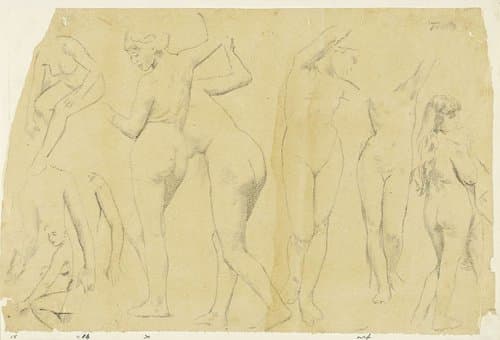
Negen studies naar vrouwelijk naakt
1846 - 1904
Medium
tracing paper
Dimensions
185; 285
Rights
Public Domain
About this artwork
Ontwerp voor een prent.
Art Historical Context
Henri Fantin-Latour's *Negen studies naar vrouw naakt* (Nine Studies of the Female Nude) showcases the French artist's meticulous approach to the human form during his formative years, spanning his active career from 1846 to 1904. A Realist painter renowned for intimate portraits, still lifes, and lithographic works, Fantin-Latour often drew from live models in Parisian ateliers, blending Romantic sensitivity with precise observation. This sheet captures nine delicate sketches of female nudes in varied poses, reflecting the academic tradition of life drawing central to 19th-century French art training. Rendered on tracing paper—a translucent medium ideal for preparatory work—these studies measure a modest 185 × 285 mm, allowing for overlays and refinements. As a *ontwerp voor een prent* (design for a print), it reveals Fantin-Latour's process in printmaking, where tracing ensured accuracy in transferring forms to etching plates or lithographic stones. This technique highlights his technical prowess and the era's emphasis on reproductive prints to disseminate artistic ideas widely. These nudes not only demonstrate anatomical study but also embody the cultural fascination with the female body in academic art, bridging classical ideals and emerging Modernism. A charming glimpse into an artist's studio practice, they invite visitors to appreciate the quiet labor behind Fantin-Latour's polished masterpieces.
About the Artist
Henri Fantin-Latour · 1836–1904
Ignace Henri Jean Théodore Fantin-Latour was born on January 14, 1836, in Grenoble, France, to portrait painter Théodore Fantin-Latour, who gave him his earliest drawing lessons. The family relocated to Paris in 1841, where in 1850, at age 14, he enrolled in the École de Dessin, studying under Horace Lecoq de Boisbaudran, whose innovative memory-based method of drawing from observation profoundly ...