
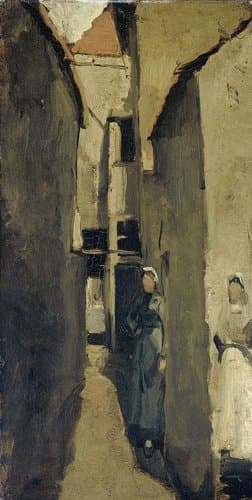
Neighborhood Street in The Hague or Scheveningen
c. 1880 - c. 1923
Medium
panel
Dimensions
9.2; 22; 34.5
Rights
Public Domain
About this artwork
M.C.J. Breitner-Jordan Bequest, Zeist
Art Historical Context
George Hendrik Breitner, a Dutch painter of the late 19th and early 20th centuries,fully captured the everyday vibrancy of urban life in *Neighborhood Street in The Hague Scheveningen* (c. 1880–1923). This intimate oil on panel (34.5 × 22 cm) offers a glimpse into the bustling streets of The Hague or its seaside neighbor Scheveningen, reflecting the rapid urbanization of the Netherlands during the Hague School era and early Impressionist influences. Breitner, often called the "painter of Amsterdam," frequently turned his eye to working-class scenes, horses, and moody atmospheres, blending Realism with loose, impressionistic brushwork to convey light, movement, and transience. Painted on a compact panel—suggesting it may be a preparatory study or personal sketch—the work exemplifies Breitner's innovative techniques: bold colors, visible strokes, and a focus on fleeting moments that democratized art by elevating ordinary cityscapes. Its small scale invites close viewing, immersing visitors in the textures of cobblestones and distant figures, a hallmark of his dynamic style. Acquired through the M.C.J. Breitner-Jordan Bequest from Zeist and now housed in the Rijksmuseum, this piece underscores Breitner's enduring legacy in preserving the pulse of Dutch daily life amid industrial change. A charming window into a bygone era!
About the Artist
George Hendrik Breitner · 1857–1923
In the early 1880s, he and Vincent van Gogh painted the residents of the working class neighborhoods of The Hague and in the province of Drenthe. Breitner moved to Amsterdam in 1886, where he became the leading painter of the Amsterdam Impressionists, documenting the urban life of Amsterdam and its residents. Comment on works: Landscapes; Views