
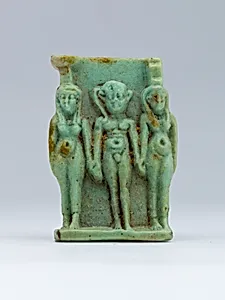
Nephthys, Horus, and Isis Amulet
Unknown Artist
664–30 B.C.
Medium
Faience
Dimensions
H. 3 × W. 2 cm (1 3/16 × 13/16 in.)
Classification
Amulet group, Nephthys, Horus, Isis
Period
Late Period–Ptolemaic Period
Department
Egyptian Art
Museum
Metropolitan Museum of Art, New York, NY
Credit
Gift of George and Florence Blumenthal, 1935
Accession Number
35.6.11
Rights
Public Domain
Tags
Art Historical Context
This delicate faience amulet, just 3 cm high and 2 cm wide, depicts the Egyptian deities Nephthys, Horus, and Isis standing side by side. Crafted during Egypt's Late Period to Ptolemaic era (664–30 B.C., Dynasties 26–30), it exemplifies the enduring tradition of protective talismans in ancient Egyptian life. Now housed in the Metropolitan Museum Art's Department of Egyptian Art, it was a generous gift from George and Florence Blumenthal 1935. Nephthys, the sister of Isis, flanks the central falcon-headed Horus, son of Isis and Osiris, while Isis herself—goddess of magic and motherhood—completes the trio. Such groupings symbolized divine safeguarding, often invoked for health, safe childbirth, or passage to the afterlife. Amulets like this were worn daily or placed in tombs, embodying the Egyptians' deep faith in the gods' intercession against misfortune. Faience, a glazed composite of quartz, lime, and clay fired to a vibrant turquoise hue, was prized for its affordability and gem-like brilliance, mimicking precious lapis lazuli. This technique highlights the artistry of Late Period craftsmen, blending piety with accessible beauty during a time of cultural continuity amid Persian and Greek influences. A tiny treasure, it reveals how everyday spirituality infused ancient Egyptian existence.