
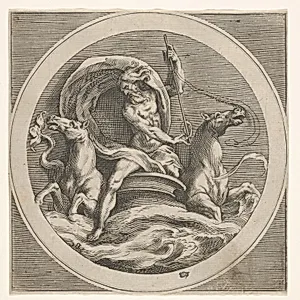
Neptune rising from the sea and bearing a staff, accompanied by two horse-headed sea creatures, reverse copy after a series of engravings by Cherubino Alberti of mythological scenes after Polidoro da Caravaggio
Medium
Engraving
Dimensions
sheet: 5 13/16 x 5 11/16 in. (14.7 x 14.5 cm)
Classification
Prints
Department
Drawings and Prints
Museum
Metropolitan Museum of Art, New York, NY
Credit
Bequest of Phyllis Massar, 2011
Accession Number
2012.136.125.4
Rights
Public Domain
Tags
Art Historical Context
This engraving captures the Roman god Neptune emerging dramatically from the sea, trident in hand, flanked by two fantastical horse-headed sea creatures. Created between 1550 and 1600, it is a reverse copy of a print by Cherubino Alberti, who himself reproduced designs by the Mannerist painter Polidoro da Caravaggio. Polidoro was renowned for his inventive mythological frescoes on Roman palace façades, and Alberti’s engravings helped preserve and circulate these ephemeral works to a wider audience. The engraving medium was especially valued during the Renaissance and Mannerist periods for its ability to translate dynamic compositions into precise, reproducible lines. By reversing the original image, this anonymous printmaker added a subtle variation while participating in a chain of artistic transmission that linked Polidoro’s inventive classical imagery to later collectors and artists. The compact sheet, measuring just under six inches square, demonstrates how such prints made grand mythological subjects accessible beyond grand architectural settings. Now in the Metropolitan Museum of Art’s collection through the bequest of Phyllis Massar, the work highlights the enduring appeal of sea gods and hybrid creatures in European art, reflecting both classical revival and the technical sophistication of 16th-century printmaking.
About the Artist
Anonymous|Cherubino Alberti (Zaccaria Mattia)|Polidoro da Caravaggio
In the vast tapestry of art history, "Anonymous" stands not as a singular individual but as a collective designation for countless unidentified creators whose works have endured across millennia. These artists, spanning prehistoric cave painters to medieval illuminators and folk craftsmen, produced the foundational layers of human visual culture. Prior to the Renaissance, when individual fame emer...