
Netsuke
Unknown Artist
18th century
Medium
Wood
Dimensions
H. (open) 2 5/16 in. (5.8 cm); H. (closed) 1 7/16 in. (3.7 cm) W. 1 5/16 in. (3.4 cm); D. 7/8 in. (2.3 cm)
Classification
Netsuke
Culture & Period
Japan · Edo period (1615–1868)
Department
Asian Art
Museum
Metropolitan Museum of Art, New York, NY
Credit
Gift of Mrs. Russell Sage, 1910
Accession Number
10.211.2061
Rights
Public Domain
Tags
Art Historical Context
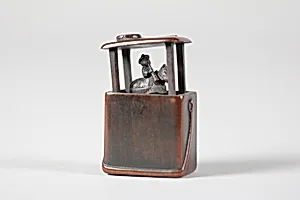
This delightful 18th-century netsuke from Japan's Edo period (16151868) exemplifies the ingenuity of everyday artistry in a time of peace and prosperity. Netsuke were small toggles carved to secure inro—lacquered medicine or tobacco cases—to a wearer's sash, as traditional kimonos lacked pockets.ed by an unknown artist from wood, a favored medium for its workability, this piece measures a compact 2 5/16 inches (5.8 cm) high when open and just 1 7/16 inches (3.7 cm) when closed, highlighting theist's skill in transforming everyday objects into whimsical sculptures. Featuring intricate carvings of animals and human figures—common motifs evoking folklore, humor or daily life—the netsuke's dual open-closed form suggests a playful, puzzle-like design popular among Edo merchants and samurai. Wood allowed for fine detailing, such as textured fur or expressive faces, demonstrating advanced techniques like himotoshi (cord holes) for functionality. These pocket-sized treasures evolved from utilitarian items into coveted collectibles, reflecting Japan's vibrant ukiyo-e culture. A generous gift to the Metropolitan Museum of Art from Mrs. Russell Sage in 1910, this netsuke invites visitors to marvel at Edo Japan's blend of practicality and poetic imagination.