
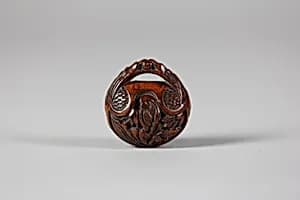
Netsuke in the form of a Nut Containing a Carved Landscape
Unknown Artist
19th century
Medium
Wood
Dimensions
Diam. 1 1/2 in. (3.8 cm); D. 1 in. (2.5 cm)
Classification
Netsuke
Culture & Period
Japan · Edo (1615–1868) or Meiji period (1868–1912)
Department
Asian Art
Museum
Metropolitan Museum of Art, New York, NY
Credit
Gift of Mrs. Russell Sage, 1910
Accession Number
10.211.2197
Rights
Public Domain
Art Historical Context
This exquisite netsuke, carved from wood in the form of a nut containing a miniature landscape, exemplifies the masterful craftsmanship of 19th-century Japan during the Edo (16151868) or early Meiji (1868–1912) period. Netsuke were essential accessories in traditional Japanese attire, serving as toggles to secure inro—small lacquered pouches carried by men for medicines, seals, or tobacco—since kimonos lacked pockets. At just 1 1/2 inches in diameter and1 inch deep, this tiny sculpture highlights the artist's ingenuity in transforming a humble nut shell into a lidded container revealing a detailed carved scene inside. The artwork's artistic significance lies in its intricate wood carving technique, a hallmark of netsuke artistry. The outer nut form mimics nature with realistic texture, while the interior landscape—likely depicting mountains, trees, or rivers—demonstrates extraordinary precision in micro-scale sculpture. Wood, though less common than ivory for netsuke, allowed for fine detailing and patina over time, showcasing the artisan's skill in balancing functionality with whimsy. A gift to the Metropolitan Museum of Art from Mrs. Russell Sage in 1910, this piece reflects Japan's rich tradition of portable art, blending utility, humor, and nature-inspired motifs. It invites visitors to marvel at how everyday objects became canvases for artistic expression in Edo-period culture.