
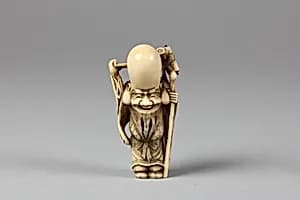
Netsuke of Fukurokujin with Karako Boy
Unknown Artist
19th century
Medium
Ivory
Dimensions
H. 2 1/2 in. (6.4 cm); W. 1 1/4 in. (3.2 cm); D. 1 1/2 in. (3.8 cm)
Classification
Netsuke
Culture & Period
Japan · Edo (1615–1868) or Meiji period (1868–1912)
Department
Asian Art
Museum
Metropolitan Museum of Art, New York, NY
Credit
Gift of Mrs. Russell Sage, 1910
Accession Number
10.211.1427
Rights
Public Domain
Tags
Art Historical Context
This exquisite netsuke, carved from ivory in 19th-century Japan during the late Edo or early Meiji, depicts Fukurokin—one of the beloved Seven Lucky Gods (Shichifukujin)—accompanied by a playful karako, a stylized Chinese child figure often symbolizing good fortune and joy. Standing just 2½ inches tall, this miniature sculpture showcases the artist's mastery of intricate ivory carving, a technique prized for its smooth texture and ability to capture fine details like flowing robes, expressive faces, and dynamic poses in a remarkably small scale. Netsuke originated as practical toggles for securing inro pouches to kimono sashes, evolving into coveted art objects by the 19th century as Western collectors admired their whimsy and craftsmanship. Fukurokujin's elongated head and sack of treasures embody wishes for longevity and prosperity, while the karako adds a touch of youthful energy, reflecting Japan's rich folklore and cultural exchange with China. Gifted to the Metropolitan Museum of Art in 1910 by Mrs. Russell Sage, this piece invites visitors to appreciate the blend of utility, spirituality, and sculptural virtuosity in everyday Japanese life.