
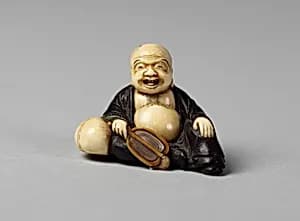
Netsuke of Hotei with a Fan
Unknown Artist
19th century
Medium
Wood and ivory
Dimensions
H. 1 1/4 in. (3.2 cm); W. 1 1/2 in. (3.8 cm); D. 7/8 in. (2.2 cm)
Classification
Netsuke
Culture & Period
Japan · Edo (1615–1868) or Meiji period (1868–1912)
Department
Asian Art
Museum
Metropolitan Museum of Art, New York, NY
Credit
Gift of Mrs. Russell Sage, 1910
Accession Number
10.211.743
Rights
Public Domain
Tags
Art Historical Context
This delicate netsuke, carved in wood and ivory during Japan’s 19th century, depicts Hotei, one of the Seven Lucky Gods revered in Japanese folklore. Known for his cheerful demeanor and cloth bag of treasures, Hotei here holds a fan, a common symbol of good fortune and protection. Netsuke served a practical purpose, acting as toggles that secured small pouches to the sashes of traditional kimono, whose lack of pockets made such accessories essential for daily life. Created during the late Edo or early Meiji period, this tiny sculpture reflects the high level of craftsmanship prized in Japanese decorative arts. Artisans combined contrasting materials—warm wood for the figure’s rounded form and smooth ivory for finer details—to achieve both durability and visual appeal. Despite its modest size of just over an inch, the piece captures Hotei’s joyful expression and flowing robes with remarkable precision. Such netsuke were often collected by enthusiasts and later entered museum collections, like this example gifted to the Metropolitan Museum of Art in 1910. They offer modern viewers a charming glimpse into Japan’s material culture, where utility and artistry beautifully intersected.