
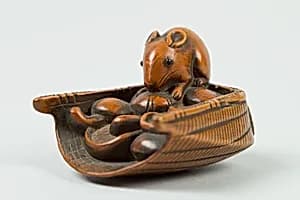
Netsuke of Mouse in a Basket of Mushrooms
Unknown Artist
19th century
Dimensions
H. 1 3/4 in. (4.4 cm); W. 1 5/8 in. (4.1 cm); D. 1 1/8 in. (2.9 cm)
Classification
Netsuke
Culture & Period
Japan · Edo (1615–1868) or Meiji period (1868–1912)
Department
Asian Art
Museum
Metropolitan Museum of Art, New York, NY
Credit
Edward C. Moore Collection, Bequest of Edward C. Moore, 1891
Accession Number
91.1.1032
Rights
Public Domain
Tags
Art Historical Context
Nestled in the Metropolitan Museum of Art's Art collection, this charming *Netsuke of Mouse in a Basket of* exemplifies the exquisite miniature artistry of 19th-century Japan, from the late Edo period (1615–1868) or early Meiji era (1868–1912). Carved by an unknown master, the piece measures just 1 3/4 inches high, showcasing the netsuke's role as a practical yet playful accessory. Before modern pockets, netsuke served as toggles to secure inro (small medicine boxes or pouches) to a kimono sash, blending functionality with whimsy. The subject—a cheeky mouse peeking from a basket brimming with mushrooms—captures Japan's love for nature-inspired motifs. Mice often symbolized resourcefulness or good fortune in folklore, while mushrooms evoked abundance and the ephemeral beauty of life. Crafted with remarkable precision for its tiny scale (1 5/8 inches wide, 1 1/8 inches deep), the sculpture highlights the virtuoso carving techniques of netsuke artists, who rendered lifelike textures from compact forms. Part of the Edward C. Moore Collection (bequeathed in 1891), it reflects the global fascination with these intricate objects during Japan's opening to the West. This delightful netsuke invites visitors to marvel at how everyday utility sparked such creative ingenuity, bridging art and daily life in Edo-Meiji Japan.