
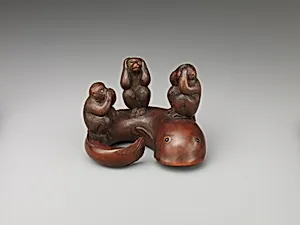
Netsuke of Three Monkeys on the Back of a Fish (Sanbiki Saru)
Unknown Artist
19th century
Medium
Wood
Dimensions
H. 1 5/16 in. (3.4 cm); W. 1 5/8 in. (4.1 cm)
Classification
Netsuke
Culture & Period
Japan · Edo (1615–1868) or Meiji period (1868–1912)
Department
Asian Art
Museum
Metropolitan Museum of Art, New York, NY
Credit
Gift of Mrs. Russell Sage, 1910
Accession Number
10.211.2216
Rights
Public Domain
Tags
Art Historical Context
Nestled in the Metropolitan Museum of Art Asian Art collection, this 19th-century woodenuke, titled *Netsuke of Threekeys on the Back of Fish (Sanbikiu)*, exemplifies the exquisite craftsmanship of Japan's Edo (1615–1868) early Meiji (186–1912) period. just 1 5/16 inches high and 1 5/ inches wide, netsuke were tiny toggles carved to secure inro (small medicine or tobacco pouches) to a samurai's sash or kim belt, as pockets were absent from traditional Japanese garments. Fashioned from wood—a common and accessible medium—these sculptures blended utility with artistry, often featuring whimsical creatures from folklore. The playful scene of three monkeys riding a fish's back captures a sense of joyful mischief, drawing on Japan's rich tradition of animal motifs in netsuke carving. Artisans employed fine chiseling techniques to render expressive faces, dynamic poses, and textured scales, all within the object's miniature scale, showcasing the precision of woodcarvers who balanced durability with intricate detail. Such pieces were collector's items among the elite, reflecting cultural values of humor, nature harmony, and everyday ingenuity. Gifted to the Met in 1910 by Mrs. Russell Sage, this unknown artist's work invites visitors to appreciate the netsuke's role in bridging functionality and fantasy, a testament to Japan's artistic legacy during a time of social transformation.