
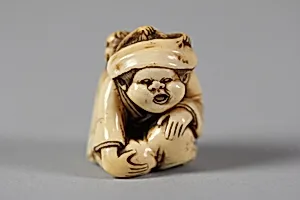
Netsuke of Woman and Monkey
Unknown Artist
19th century
Medium
Ivory
Dimensions
H. 1 1/2 in. (3.8 cm); W. 1 1/8 in. (2.9 cm)
Classification
Netsuke
Culture & Period
Japan · Edo (1615–1868) or Meiji period (1868–1912)
Department
Asian Art
Museum
Metropolitan Museum of Art, New York, NY
Credit
Gift of Mrs. Russell Sage, 1910
Accession Number
10.211.956
Rights
Public Domain
Tags
Art Historical Context
Nestled in the Metropolitan Museum of Art's Art collection, this exquisiteNetsuke of Woman and Monkey* is 19th-century ivory carving from Japan, likely from the late Edo (1615–1868) or early Me (1868–1912) period. Measuring just 1 1/2 inches high and 1 1/8 inches wide, its diminutive scale belies the artist's masterful detail—capturing a playful interaction between a woman and monkey in a dynamic, intimate pose. Gifted by Mrs. Russell Sage in 0, it exemplifies the refined craftsmanship of anonymous Japanese artisans. Netsuke were essential accessories in traditional Japanese dress, serving as toggles to secure inro (small lacquered cases for medicines or seals) to silk kimono sashes. Carved from ivory, this piece highlights the material's prized translucency and workability, allowing for intricate textures like fur, flowing hair, and subtle facial expressions. During the Edo and Meiji eras, netsuke evolved from utilitarian objects into coveted art forms, often depicting animals, figures, or mythical scenes with humor and vitality. Monkeys, a recurring motif in Japanese art, symbolize mischief and cleverness, adding whimsy to this everyday artifact. Its survival as a collector's gem invites us to appreciate how such tiny sculptures bridged functionality and artistry in feudal Japan, offering a window into a vibrant cultural world.