
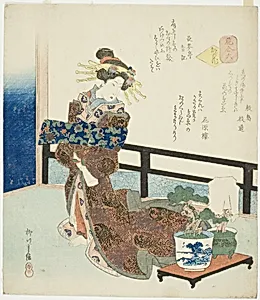
No. 6: Flower of the Capital (Miyako no hana), from the series "A Comparison of Flowers (Hana awase)"
late 1820s
Medium
Color woodblock print; shikishiban, surimono
Dimensions
20.8 × 18.2 cm (8 3/16 × 7 3/16 in.)
Classification
woodblock print
Department
Arts of Asia
Museum
Art Institute of Chicago
Accession Number
81532
Rights
Public Domain
Art Historical Context
Behold the delicate charm of *No. 6 Flower of the CapitalMiyako no hana, a gem from Yanagawa Shigenobu's series *A Comparison of Flowers (Hana aw)*, created in the late 1820s during Japan's vibrant Edo period. Shigenobu II, a skilled ukiyo-e artist for his refined depictions of beauties and nature, crafted this intimate square-format print (shikishiban) to evoke the poetic elegance of urban life. The title playfully merges floral imagery with the splendor of the capital—likely Kyoto—personifying its grace as a blooming flower amid the "floating world" of fleeting pleasures. This color woodblock print exemplifies *surimono*, privately commissioned luxury editions often produced for New Year's greetings or poetic gatherings among literati. Measuring just 20.8 × 18.2 cm, its compact size suited personal albums, while advanced techniques like precise carving, vibrant pigments, and subtle embellishments (such as mica dusting or embossing) delivered museum-quality finesse beyond commercial ukiyo-e. In an era of tightening censorship, surimono offered artistic freedom, blending visual beauty with cultural wit. Housed in the Art Institute of Chicago's Arts of Asia collection, this work captures the era's fascination with *hana awase*—flower contests symbolizing refined taste and seasonal harmony. It invites visitors to savor the interplay of color, composition, and cultural poetry in miniature form.