
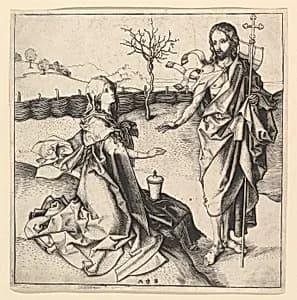
Noli me Tangere
ca. 1470–74
Medium
Engraving
Classification
Prints
Department
Drawings and Prints
Museum
Metropolitan Museum of Art, New York, NY
Credit
Harris Brisbane Dick Fund, 1932
Accession Number
32.64.2
Rights
Public Domain
Tags
About this artwork
This prints by german artist Martin Schongauer exemplifies the artistic achievements of ca. 1470–74. The artist's work in engraving demonstrates the importance of printmaking as both an artistic medium and a means of disseminating images widely. Executed in engraving, this work demonstrates the sophisticated technical processes involved in printmaking. The medium required specialized knowledge of materials, tools, and procedures, including preparing plates or blocks, applying ink, and achieving ...
Art Historical Context
In the Drawings and Prints department of the Metropolitan Museum of Art, Martin Schongauer's *Noli me Tangere* (ca. 1470–74) stands as a pinnacle of early German engraving. This evocative print captures a sacred biblical encounter—likely the risen Christ speaking to the Virgin Mary amid symbols of the Cross—infused with spiritual depth and emotional resonance. As one of the era's leading artists, Schongauer exemplified the technical and aesthetic innovations of late 15th-century Germany, bridging medieval traditions with emerging Renaissance ideals. Crafted through the meticulous art of engraving, the work showcases sophisticated processes: incising designs into metal plates, inking them, and pressing paper to yield multiple impressions. This labor-intensive medium demanded mastery of tools and materials, allowing Schongauer to achieve fine lines, rich textures, and tonal depth that rivaled painting. His engravings were revolutionary, enabling widespread dissemination of images beyond elite patrons to scholars, artisans, and the growing middle class. Acquired through the Harris Brisbane Dick Fund in 1932, *Noli me Tangere* highlights printmaking's democratizing power. It transformed art from singular objects into reproducible treasures, fueling cultural exchange and influencing masters like Albrecht Dürer. Today, it illuminates the vibrant artistic practices of its time, inviting us to appreciate how technology expanded creativity's reach.
About the Artist
Martin Schongauer · 1435–1491
Martin Schongauer, born around 1450–1453 in Colmar, Alsace, emerged from a family of skilled artisans. The third of four or five sons of goldsmith Caspar Schongauer, who had relocated from Augsburg to Colmar around 1440, Martin was immersed in the goldsmith's trade from youth, likely receiving his initial training in his father's workshop—a common path for early engravers. He further honed his ski...