
North Side of the West Wall of Nakht's Offering Chapel
1908–1914; original ca. 1410–1370 B.C.
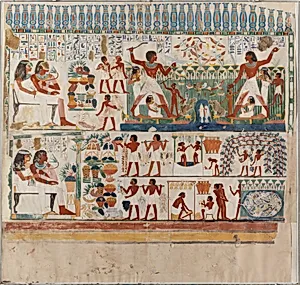
Medium
Tempera on paper
Dimensions
Framed: H. 194.3 cm (76 1/2 in.); w. 203.8 cm (80 1/4 in.); th. 3.2 cm (1 1/4 in.) Scale: 1:1
Classification
Facsimile, TT 52, fishing, fowling, wine making, clap net,
Period
Twentieth Century; original New Kingdom
Department
Egyptian Art
Museum
Metropolitan Museum of Art, New York, NY
Credit
Rogers Fund, 1915
Accession Number
15.5.19e, l–m
Rights
Public Domain
Tags
Art Historical Context
Step into the vibrant world of ancient Egypt with this stunning life-size facsimile of the north side of the wall from Nakht's offering chapel in his Theban tomb (TT52). Dating to the New Kingdom's 18th Dynasty (. 1410–1370 B.C.), the original wall paintings adorned the tomb of Nakht, a high-ranking official and astronomer under Pharaohs like Thutmose IV. These scenes, rich with men, women, hieroglyphs, food, birds,, wine, hunting, fish, vividly capture the Egyptian belief in the afterlife: offerings of sustenance and joyful activities to nourish the ka (spirit) eternally. Created between 1908 and 1914 by a team of skilled Egyptologists—Francis Sydney Unwin, Hugh R. Hopgood, Norman de Garis Davies, and Lancelot Crane—this tempera-on-paper copy at 1:1 scale preserves every detail with remarkable fidelity. The Davies team's meticulous work, now at the Metropolitan Museum of Art (Rogers Fund, 1915), exemplifies early 20th-century archaeological documentation, allowing us to study faded originals without damage. Such facsimiles reveal the Egyptians' masterful use of flat, symbolic figures, bright colors, and hierarchical scale, blending daily life with ritual to affirm prosperity beyond death. (198 words)