
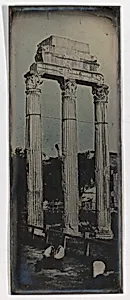
Northwest Facade, Temple of Castor and Pollux, Rome (12. Rome. 1842. Graecostasis. faç. N.O.)
Medium
Daguerreotype
Dimensions
Image: 9 7/16 × 3 11/16 in. (24 × 9.4 cm)
Classification
Photographs
Department
Photographs
Museum
Metropolitan Museum of Art, New York, NY
Credit
Purchase, Mr. and Mrs. John A. Moran Gift, in memory of Louise Chisholm Moran, Joyce F. Menschel Gift, Joseph Pulitzer Bequest, 2016 Benefit Fund, and Gift of Dr. Mortimer D. Sackler, Theresa Sackler and Family, 2016 (2016.606)
Accession Number
2016.606
Rights
Public Domain
Tags
Art Historical Context
Joseph-Philibert Girault de Prangey created this striking daguerreotype in 1842, capturing the northwest facade of the Temple of Castor and Pollux in Rome’s Forum. A French photographer and architectural historian, Girault de Prangey was among the earliest practitioners to travel with the new medium, documenting ancient sites across Europe and the Mediterranean. The image’s narrow, elongated format highlights the three surviving Corinthian columns that have long symbolized the grandeur of Republican Rome. As one of the first photographic processes, the daguerreotype offered unprecedented sharpness and detail, allowing viewers to study weathered marble surfaces and architectural proportions with remarkable clarity. Produced just three years after photography’s public announcement, this work reflects the 19th-century fascination with classical antiquity and the desire to preserve its remains through a seemingly objective lens. Today the print stands as both an archaeological record and a pioneering work of photographic art, bridging ancient history with the birth of modern image-making.
About the Artist
Joseph-Philibert Girault de Prangey · 1804–1892
Joseph-Philibert Girault de Prangey (1804–1892), born in Langres, France, as the sole surviving child of Claude Joseph Girault and Barbe Philiberte Rosine Piétrequin, inherited the lordships of Genevrières and Prangey, adopting his full surname in 1825. After studies at Langres college and in Paris, where he earned baccalauréats in letters (1826) and law (1828), he pursued artistic training under ...