
Nova Iconologia
Medium
Woodcut
Dimensions
Overall: 8 7/8 x 6 1/2 in. (22.5 x 16.5 cm)
Classification
Books
Department
Drawings and Prints
Museum
Metropolitan Museum of Art, New York, NY
Credit
Harris Brisbane Dick Fund, 1943
Accession Number
43.121
Rights
Public Domain
Tags
Art Historical Context
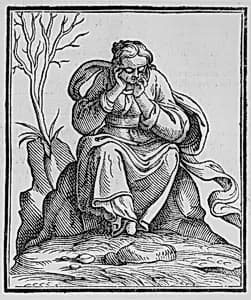
This 1618 edition of *Nova Iconologia*, published in Padua by Pietro Paulo To and based on Cesare Ripa’s influential emblem book, served as an essential reference for artists seeking to depict abstract ideas through human figures. First compiled in the late sixteenth century, Ripa’s work cataloged allegorical personifications drawn from classical mythology, history, and moral philosophy, helping painters and sculptors translate concepts like virtues and vices into visual form. The Met’s copy, a compact woodcut volume measuring just under nine inches tall, reflects the practical nature of such manuals, which traveled easily between studios across Europe. The woodcut illustrations emphasize expressive human figures engaged in contemplative poses, inviting viewers to decode symbolic attributes such as, clothing, and surrounding objects. As a printed book rather than a unique drawing or painting, this work highlights the growing role of reproductive media in shaping artistic vocabulary during the Baroque period. Its presence in the Museum’s Drawings and Prints collection underscores how printed resources like *Iconologia* democratized iconographic knowledge, influencing generations of artists well into the eighteenth century.
About the Artist
Cesare Ripa|Pietro Paulo Tozzi (Italian|Italian) · 1555 |1593 –1622 |1628
Italian, Perugia ca. 1555–probably 1622 Rome|Italian, active 1593–1628