
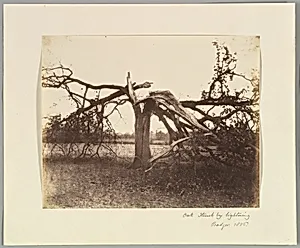
Oak Struck by Lightning, Badger, 1856.
Medium
Albumen silver print from paper negative
Dimensions
Image: 18 x 22.7 cm (7 1/16 x 8 15/16 in.) Mount: 25.2 x 30.5 cm (9 15/16 x 12 in.)
Classification
Photographs
Department
Photographs
Museum
Metropolitan Museum of Art, New York, NY
Credit
Purchase, The Buddy Taub Foundation Gift, Dennis A. Roach and Jill Roach, Directors, 2012
Accession Number
2012.112
Rights
Public Domain
Tags
Art Historical Context
Alfred Capel Cure's *Oak Struck by Lightning, Badger* (1856) is a striking early photograph capturing the raw power of nature. Created using the calotype process—an albumen silver print from a paper negative—this 18 x 22.7 cm image exemplifies mid-19th-century photography's pioneering techniques. Cure, a British landowner and amateur photographer, was renowned for his meticulous documentation of ancient trees, particularly oaks, which he viewed as living monuments of Britain's landscape heritage. The paper negative allowed for detailed textures and subtle tones, rendering the lightning-scarred bark and the badger's form with remarkable clarity. This work reflects the Romantic fascination with the sublime: the oak, dramatically split by lightning, symbolizes nature's untamed force, while the badger adds a touch of wildlife intimacy. Photographed at Badger, likely in England's countryside, it highlights Cure's passion for arboreal subjects, predating more formal tree studies. As one of the earliest photographic essays on trees, it bridges art and science, influencing later landscape photographers. Today, housed in the Metropolitan Museum of Art (purchase, The Buddy Taub Foundation Gift, 2012), this print invites visitors to ponder photography's role in preserving fleeting natural dramas, a testament to Cure's innovative eye in 1856.
About the Artist
Alfred Capel Cure · 1826–1896
Alfred Capel Cure (1826–1896) was a British artist whose career unfolded during the Victorian era, a period of remarkable diversity and ambition in British art. Active in a landscape tradition shaped by the achievements of John Constable and J.M.W. Turner, Cure worked at a time when watercolor and drawing held an especially prominent place in English artistic culture, embraced both by professional...