
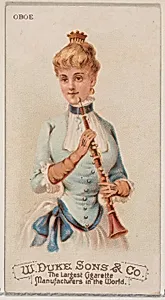
Oboe, from the Musical Instruments series (N82) for Duke brand cigarettes
Medium
Commercial color lithograph
Dimensions
Sheet: 2 3/4 x 1 1/2 in. (7 x 3.8 cm)
Classification
Prints|Ephemera
Department
Drawings and Prints
Museum
Metropolitan Museum of Art, New York, NY
Credit
The Jefferson R. Burdick Collection, Gift of Jefferson R. Burdick
Accession Number
63.350.204.82.34
Rights
Public Domain
Tags
Art Historical Context
This charming chromolithograph, titled *Oboe* from the Musical Instruments series (N82 was produced in 1888 by W. Duke, Sons & Co. in collaboration with printers Schumacher & Ettlinger. as a trade card for Duke brand cigarettes, it belongs to a popular set of collectible cards featuring various instruments, likely depicting an oboe alongside a woman musician—a nod to the era's interest in women in music and domestic arts. At just 2¾ x 1½ inches, these tiny ephemera were tucked into cigarette packs to entice collectors, transforming everyday tobacco promotion into a hobby. Chromolithography, the medium here, revolutionized commercial printing in the late 19th century with its vibrant, multi-layered colors applied via stone plates. This technique allowed mass production of eye-catching images at low cost, making art accessible beyond elite circles. Duke's cards, part of the competitive "cigarette card craze," helped the company dominate the market and foreshadowed modern trading cards. Housed in the Metropolitan Museum of Art's Drawings and Prints department as part of The Jefferson R. Burdick Collection, this piece highlights Gilded Age advertising ingenuity and cultural fascination with music. A delightful glimpse into Victorian leisure!
About the Artist
W. Duke, Sons & Co.|Schumacher & Ettlinger · 1870–1920
**W. Duke, Sons & Co.: Pioneers of Chromolithographic Trade Card Art** W. Duke, Sons & Co., an American tobacco manufacturer, emerged from the entrepreneurial vision of Washington Duke (1820–1905) and his sons in Durham, North Carolina. After the Civil War, Washington abandoned farming in 1874 to join his eldest son, Brodie L. Duke, in the burgeoning tobacco trade, establishing a factory that for...