
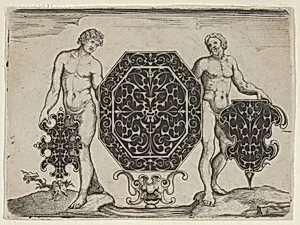
Octagonal Case and Two Other Motifs Held by Ignudi
Medium
Blackwork and Engraving
Dimensions
Plate: 3 1/16 x 4 3/16 in. (7.8 x 10.6 cm)
Classification
Prints|Ornament & Architecture
Department
Drawings and Prints
Museum
Metropolitan Museum of Art, New York, NY
Credit
Harris Brisbane Dick Fund, 1924
Accession Number
23.101.6
Rights
Public Domain
Tags
Art Historical Context
In the early Baroque era, Giovanni Battista Costantini crafted *Octagonal Case and Two Motifs Held by Ign* in 1622, a delicate engraving that exemplifies the ornamental printmaking popular among Italian artists of the time. This small plate, measuring just 3 1/16 x 4 3/16 inches, belongs to the Metropolitan Museum of's Drawings and Prints collection, acquired through the Harris Brisbane Dick Fund 1924. Costantini, a skilled engraver from the Veneto, specialized in intricate designs for architecture and decoration, blending classical motifs with dynamic figures. The print features muscular ignudi—nude male figures inspired by ancient Greco-Roman sculpture and Michelangelo's Sistine Chapel—gracefully supporting an octagonal case and two other elaborate motifs. Rendered in blackwork, a technique of fine, cross-hatched lines that creates rich tonal depth and texture, the engraving showcases Costantini's mastery of intaglio printing. This method allowed for precise, reproducible patterns prized by craftsmen for gilding, furniture, or architectural embellishments. Such works held cultural importance in 17th-century Europe, serving as pattern books for artisans during the opulent Baroque age. They bridged art and design, disseminating ideal proportions and fantastical ornaments that reflected the era's fascination with grandeur and the male form as a symbol of vitality and harmony. A charming glimpse into Renaissance-to-Baroque transitions!