
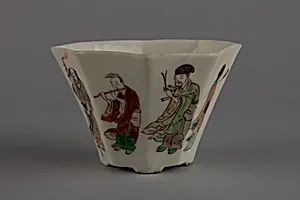
Octagonal cup with the Eight Immortals
Unknown Artist
17th century
Medium
Porcelain painted in overglaze polychrome enamels (Dehua ware)
Dimensions
H. 2 3/4 in. (7 cm)
Classification
Ceramics
Culture & Period
China · Qing dynasty (1644–1911)
Department
Asian Art
Museum
Metropolitan Museum of Art, New York, NY
Credit
Rogers Fund, 1917
Accession Number
17.118.14
Rights
Public Domain
Tags
Art Historical Context
This delicate octagonal cup, crafted in 17th-century China during the early Qing dynasty, exemplifies the refined porcelain traditions of Dehua ware from Fujian province. Standing only2 3/4 inches tall, the vessel is formed from fine white porcelain and decorated with overglaze polychrome enamels, a technique that allowed artisans to apply vibrant colors after the initial firing. Such small cups were likely used for tea or wine, blending everyday utility with artistic expression. The surface features the Eight Immortals, a beloved group of Daoist figures from Chinese mythology, shown alongside motifs of music and flutes. These immortals, each with distinct attributes, represent ideals of longevity, wisdom, and harmony with nature, making their presence on functional objects a subtle reminder of cultural values. Acquired by the Metropolitan Museum of Art in 1917 through the Rogers Fund, this piece highlights the Qing era’s mastery of enameled ceramics and the enduring appeal of mythological themes in Chinese art. Its compact size and lively decoration invite viewers to appreciate how even modest household items carried rich symbolic meaning.