
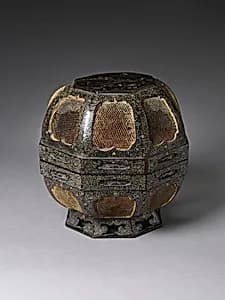
Octagonal food box with Chinese immortals and floral design
Unknown Artist
18th century
Medium
Lacquered wood; mother-of-pearl inlay, gold leaf application on black ground and gilded metal net inserts
Dimensions
H. 10 5/8 in. (27 cm); W. 10 1/2 in. (26.7 cm); H. (base:) 1 7/16 in. (3.6 cm)
Classification
Lacquer
Culture & Period
Japan (Ryūkyū Islands, now Okinawa Prefecture) · Edo period (1615–1868)
Department
Asian Art
Museum
Metropolitan Museum of Art, New York, NY
Credit
Purchase, Friends of Asian Art Gifts, 2019
Accession Number
2019.106a, b
Rights
Public Domain
Art Historical Context
This exquisite octagonal food box hails from the Ryūkyū Islands—now Okinawa Prefecture, Japan—crafted during the 18th in the Edo period (1615–1868). Measuring about 10.5 inches across and standing 10.6 inches tall with a low base, it served as a luxurious tiered container for serving delicacies, blending everyday utility with opulent artistry. The black lacquered wood ground shimmers with intricate mother-of-pearl inlays (known as *raden*) depicting Chinese immortals amid blooming florals, enhanced by gold leaf and gilded metal net inserts that catch the light like jewels. Ryūkyū lacquerware was renowned across East Asia for its technical mastery, fusing Japanese *makie* (gold-sprinkled lacquer) traditions with Chinese motifs and local innovations. The immortals—legendary Taoist figures symbolizing longevity and harmony—reflect the kingdom's role as a cultural bridge between China, Japan, and beyond, as Ryūkyū artisans exported these treasures to elite patrons. The iridescent mother-of-pearl, sourced from local seas, creates a radiant, three-dimensional effect, while the octagonal form evokes harmony and completeness in Asian aesthetics. Today, this rare piece at the Metropolitan Museum of Art highlights Ryūkyū's artistic legacy, a vibrant chapter of Japan's peripheral brilliance. Imagine it gracing a shogun's banquet, where beauty elevated even the simplest meal!