
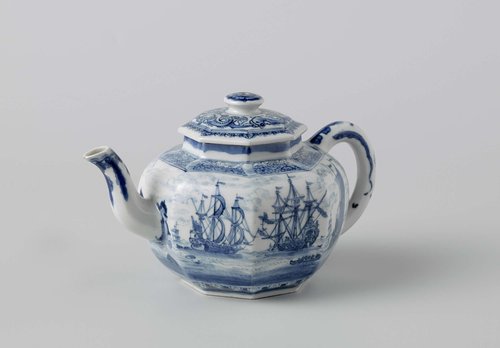
Octagonal teapot with a seascape with European ships
ca. 1725 - ca. 1749
Medium
turning
Dimensions
11
Rights
Public Domain
About this artwork
Achthoekige theepot van porselein met een S-vormige tuit en C-vormig oor, beschilderd in onderglazuur blauw. Op de buik een zeegezicht met Europese schepen. Boven de voet een decoratieve band. Op de schouder een band met acht vakken met bloemranken. De tuit en de schouder met bloemranken en wolkmotieven. De deksel met bladranken en een band met bladeren. Een gestileerde bloem op de deksel. Gemerkt op de onderzijde met het zes-karaktermerk van keizer Chenghua. Blauw-wit.
Art Historical Context
This exquisite octagonal teapot, crafted around 1725–1749, exemplifies the pinnacle of Chinese blue-and-white porcelain from the Jingdezhen kilns during the Qing dynasty's Yongzheng or early Qianlong reign. Standing just 11 cm tall, its faceted octagonal form is meticulously shaped through turning—a lathe-based technique that allowed for precise, geometric elegance. Adorned in underglaze cobalt blue, the teapot features an S-shaped spout, C-form handle, and a lively seascape on its belly depicting European ships sailing amid waves, a nod to the era's booming maritime trade. The decoration bursts with intricate motifs: floral scrolls in eight shoulder panels, cloud patterns on the spout and shoulders, leafy bands on the lid topped by a stylized flower, and a decorative foot ring. Notably, it bears a six-character reign mark of Emperor Chenghua (1465–1487) on the base—a common apocryphal mark on later high-quality wares, signaling prestige rather than authenticity. This piece likely served the European export market, blending Chinese artistry with exotic Western imagery to captivate 18th-century collectors. As a functional yet opulent artifact, it highlights porcelain's role in global exchange, where East met West on tabletops. Its enduring appeal lies in the masterful underglaze technique, firing vivid blues beneath a glossy glaze for timeless vibrancy.
About the Artist
anonymous
In the vast tapestry of art history, "Anonymous" stands not as a singular individual but as a collective designation for countless unidentified creators whose works have endured across millennia. These artists, spanning prehistoric cave painters to medieval illuminators and folk craftsmen, produced the foundational layers of human visual culture. Prior to the Renaissance, when individual fame emer...