
Old Village (Ville vieille)
1826 to 1850
Medium
etching and drypoint?
Classification
Department
CG-E
Museum
National Gallery of Art, Washington, D.C.
Credit
Rosenwald Collection
Accession Number
1943.3.5474
Rights
Public Domain
Art Historical Context
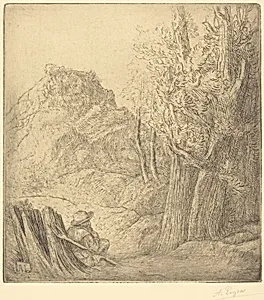
Alphonse Legros's *Old Village (Ville vieille, created between 1826 and 1850, is a delicate etching and drypoint from the National Gallery of Art Rosenwald Collection. Born in France in 1837, Legros was a pivotal figure in 19th-century printmaking, bridging Realism and the etching revival. Though early in his career, this captures his affinity for rural subjects, evoking the timeless charm of a French village through intricate lines and subtle textures. Etching and drypoint techniques here: etching uses acid to etch precise lines into a copper plate, while drypoint's direct needle scratches create velvety burrs for rich, atmospheric depth. This combination allowed Legros to achieve tonal subtlety and emotional resonance in prints, making fine art accessible beyond paintings. As a print, it exemplifies the democratic medium of the era, enabling wider dissemination of Realist visions of everyday life. Housed in the NGA's Department CG-E, *Old Village* reflects Legros's influence across France and England, where he later taught. It invites viewers to ponder the enduring allure of vanishing rural traditions amid industrialization, a subtle nod to cultural shifts in 19th-century Europe. A gem for print enthusiasts!
About the Artist
Alphonse Legros · 1837–1911
Alphonse Legros (1837–1911) was born in Dijon, France, and trained in Paris at the drawing school of Horace Lecoq de Boisbaudran, whose unconventional teaching method — which emphasised memory drawing and acute observation over academic convention — would leave a lasting mark on Legros's practice. At Lecoq's school he formed friendships with Jules Dalou and Auguste Rodin that endured throughout hi...