
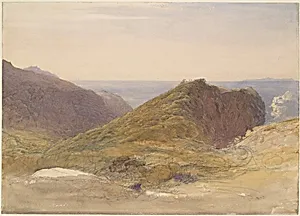
On the North Coast of Devon, Lundy Island in the Distance
ca. 1835
Medium
Watercolor and black chalk over graphite with touches of gouache (bodycolor)
Dimensions
sheet: 10 11/16 x 14 15/16 in. (27.1 x 38 cm)
Classification
Drawings
Department
Drawings and Prints
Museum
Metropolitan Museum of Art, New York, NY
Credit
Rogers Fund, 1970
Accession Number
1970.178
Rights
Public Domain
Tags
Art Historical Context
Samuel Palmer's *On the North Coast of, Lundy Island in Distance* (ca. 1835) captures the dramatic beauty of England's rugged shoreline, with the misty outline of Lundy Island shimmering on the horizon amid rolling hills and coastal cliffs. A leading figure in British Romanticism and a member of the visionary "Ancients" circle influenced by William Blake, Palmer his landscapes with a poetic reverence for nature's sublime power. This work reflects his post-Shoreham period interest in direct observation of the British countryside, blending intimate detail with expansive atmosphere. Crafted on a modest sheet measuring 10 11/16 x 14 15/16 inches (27.1 x 38 cm), the drawing employs watercolor and black chalk over graphite, accented by touches of gouache (bodycolor) for heightened luminosity and texture. These mixed-media techniques—hallmarks of Palmer's draftsmanship—allow soft gradations of light to evoke the sea's sparkle and the land's earthy depth, bridging preparatory sketch and finished vision in the tradition of 19th-century British topographical art. Acquired through the Rogers Fund in 1970 and housed in the Metropolitan Museum of Art's Drawings and Prints department, this piece invites visitors to ponder Palmer's enduring legacy: transforming everyday vistas into timeless meditations on the harmony between humanity and the wild Devon landscape.
About the Artist
Samuel Palmer · 1805–1881
Samuel Palmer was born on 27 January 1805 in Newington, London, the son of a bookseller and sometime Baptist minister. He had little formal schooling and almost no conventional artistic training, yet he possessed an instinctive gift for drawing that led him to exhibit Turner-inspired works at the Royal Academy when he was only fourteen years old. In 1824 his mentor, the painter John Linnell, intro...