
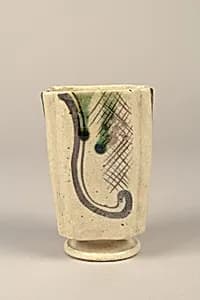
One from set of five squared food vessels (mukōzuke) for tea-gathering meal
Unknown Artist
early 17th century
Medium
Stoneware with iron-oxide and copper green overglaze decoration (Mino ware, Yashichida Oribe type)
Dimensions
H. 3 7/8 in. (9.8 cm); W. 2 7/8 in. (7.3 cm)
Classification
Ceramics
Culture & Period
Japan · Momoyama (1573–1615) or Edo (1615–1868) period
Department
Asian Art
Museum
Metropolitan Museum of Art, New York, NY
Credit
Purchase, Mary Livingston Griggs and Mary Griggs Burke Foundation Gift, 1973
Accession Number
1973.80.5
Rights
Public Domain
Art Historical Context
This delicate squared food vessel, known as a *mukōzuke*, is one from a set of five designed for serving side dishes during intimate tea-gathering meals in early 17th-century Japan Part of the Momoyama or Edo period, it reflects the refined aesthetics of the tea ceremony (*chanoyu*), where humble ceramics elevated everyday rituals into profound artistic experiences. Its compact size—standing just under 4 inches tall and wide—made it ideal for sharing small, seasonal morsels amid gatherings of samurai, merchants, and tea masters. Crafted in Mino ware, a renowned stoneware tradition from central Japan, this piece exemplifies Yashichida Oribe type pottery. Artisans applied iron-oxide for reddish-brown accents and copper green overglaze, fired at high temperatures to create a vibrant, irregular surface that dances with light. Oribe wares, inspired by the bold tastes of tea master Furuta Oribe, favored asymmetrical forms and spontaneous glazes, breaking from earlier symmetries to embody *wabi-sabi*—the beauty in imperfection. These vessels highlight Japan's ceramic innovation during a time of cultural flourishing, bridging the opulent Momoyama era and the stability of Edo. Acquired by The Metropolitan Museum of Art in 1973 through the Mary Griggs Burke Foundation, it invites visitors to savor the sensory poetry of tea culture, where form, function, and fleeting beauty converge.