
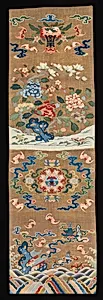
One of a Pair of Chair Strips with Auspicious Patterns
Unknown Artist
18th century
Medium
Tapestry-woven (kesi) silk and metallic thread
Dimensions
Overall: 64 x 19 in. (162.6 x 48.3 cm)
Classification
Textiles-Tapestries
Culture & Period
China · Qing dynasty (1644–1911)
Department
Asian Art
Museum
Metropolitan Museum of Art, New York, NY
Credit
Rogers Fund, 1965
Accession Number
65.210.1
Rights
Public Domain
Tags
Art Historical Context
This exquisite *One of a Pair of Strips with Ausp Patterns*, crafted in 18th-century China during the Qing dynasty (164–1911), served as a decorative guard or cover for chair arms, blending functionality with imperial elegance. Measuring 64 x 19 inches, these long, narrow textiles were likely used in elite households or palaces, where such furnishings symbolized status and harmony. The Rogers Fund acquisition in 1965 brought this treasure to the Metropolitan Museum of's Asian Art collection. oven in the intricate *kesi* technique—a discontinuous weft tapestry method using silk and metallic threads—the strip showcases meticulous craftsmanship. Fine slits between color areas allowed for vibrant, detailed motifs without supplementary wefts, a hallmark of Qing textile artistry prized for its precision and luminosity. Dominant patterns of bats (symbolizing *fu*, or happiness), undulating waves (evoking longevity and prosperity), and blooming flowers (representing wealth and fertility) form a tapestry of good fortune, reflecting Confucian ideals of balance and abundance central to Chinese culture. These chair strips highlight the Qing era's opulent textile production, where auspicious symbols warded off misfortune and invited blessings. Visitors can appreciate how everyday objects became canvases for cultural aspirations, shimmering with metallic threads under gallery lights.