
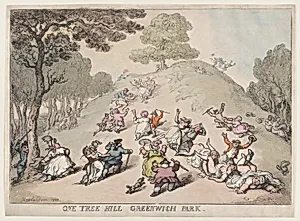
One Tree Hill, Greenwich Park
Medium
Hand-colored etching
Dimensions
Sheet: 10 9/16 × 14 1/2 in. (26.8 × 36.8 cm)
Classification
Prints
Department
Drawings and Prints
Museum
Metropolitan Museum of Art, New York, NY
Credit
The Elisha Whittelsey Collection, The Elisha Whittelsey Fund, 1959
Accession Number
59.533.572
Rights
Public Domain
Tags
Art Historical Context
Thomas Rowlandson's *One Tree Hill, Greenwich Park (1802) captures a lively satirical scene in one of London's most beloved green spaces. As a master of Georgian caricature, Rowlandson delights in poking fun at everyday social antics, here depicting men and women strolling, flirting, and lounging amid the park's rolling hills. Greenwich Park, with its iconic One Tree Hill offering panoramic views of the Thames, was a popular 19th-century retreat forers seeking fresh air and flirtation, making it fertile ground for Rowlandson's humorous observations. Rendered as a hand-colored etching, this print exemplifies the artist's virtuoso technique: fine lines etched into copper plates for intricate details, then meticulously colored by hand to add vibrant life and exaggerated expressions. Such affordable, reproducible works democratized art, allowing middle-class audiences to enjoy Rowlandson's witty critiques of Regency-era manners—from dandies preening to couples canoodling—without visiting elite exhibitions. Housed in the Metropolitan Museum of Art's Drawings and Prints department, this piece highlights Rowlandson's enduring legacy in British satire, blending sharp social commentary with playful exaggeration. Visitors today can appreciate how it freezes a moment of leisurely park life, reminding us of timeless human follies.
About the Artist
Thomas Rowlandson · 1756–1827
Thomas Rowlandson (1757–1827) was an English artist and caricaturist whose satirical watercolors and prints captured the social life of Georgian Britain with unparalleled wit and technical mastery. Alongside James Gillray, he is recognized as one of the greatest British graphic artists, and his distinctive flowing line and keen observations have made his work integral to understanding late 18th an...