
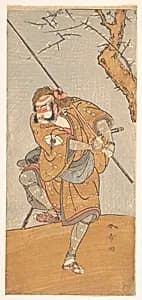
Onoe Matsusuke in the Role of Asahina in "Edo no Haru Meisho Soga"
Medium
Woodblock print (nishiki-e); ink and color on paper
Dimensions
12 11/32 x 5 1/2 in. (31.4 x 14.0 cm)
Classification
Prints
Culture & Period
Japan · Edo period (1615–1868)
Department
Asian Art
Museum
Metropolitan Museum of Art, New York, NY
Credit
Purchase, Joseph Pulitzer Bequest, 1918
Accession Number
JP402
Rights
Public Domain
Tags
Art Historical Context
Step into the vibrant world of Edo-period Japan with Katsukawa Shunshō's 1773 woodblock print, *Onoe Matsusuke in the Role of Asahina in "Edo no Haru Meisho Soga"*. This nishiki-e, or "brocade picture," showcases the renowned kabuki actor Onoe Matsusuke I in a dynamic pose as the warrior Asahina from a popular play blending revenge drama with Edo's scenic spring beauty. Shunshō, a master of the Katsukawa school and pioneer of ukiyo-e actor portraits (yakusha-e), captures the star's expressive features and theatrical costume with remarkable immediacy. Produced during Japan's Edo period (1615–1868), a time of urban prosperity and entertainment boom in Edo (modern Tokyo), this print reflects kabuki's cultural dominance. Actors like Matsusuke were celebrities, idolized by fans who collected such prints as affordable souvenirs. The nishiki-e technique—using multiple woodblocks for layered colors and intricate details—revolutionized printmaking, making lavish visuals accessible beyond the elite. Housed in the Metropolitan Museum of Art's Asian Art collection, this 12 11/32 x 5 1/2-inch gem highlights Shunshō's skill in conveying motion and personality, offering a window into 18th-century Japan's "floating world" of theater and fleeting pleasures.
About the Artist
Katsukawa Shunshō 勝川春章 (Japanese) · 1726 –1792
Japanese, 1726–1792