
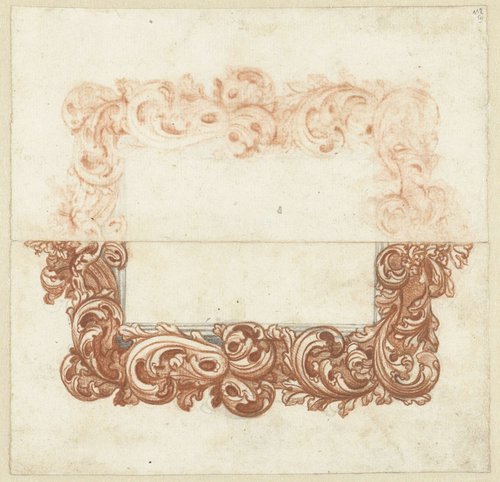
Ontwerp voor een lijst met acanthusbladeren
1600 - 1699
Medium
counterproof
Dimensions
168; 172
Rights
Public Domain
About this artwork
height 168 mm x width 172 mm
Art Historical Context
**Ontwerp voor een lijst met acanthusbladeren** *Anonymous, 1600–1699, counterproof, 168 × 172 mm* This delicate 17th-century drawing presents an elegant design for a picture frame adorned with acanthus leaves, a timeless motif rooted in ancient Greco-Roman architecture. Crafted anonymously during the Baroque era, it exemplifies the ornate decorative arts flourishing in Northern Europe, particularly in the Dutch and Flemish workshops where such patterns guided gilders and framemakers. The small scale—barely larger than a postcard—suggests it was a practical working sketch, capturing the flowing, voluptuous curves of acanthus foliage that symbolized vitality and classical grandeur. What makes this piece intriguing is its medium: a *counterproof*, created by pressing a fresh sheet against an inked original to produce a mirror-image impression. This technique, popular among printmakers and designers, allowed artists to review compositions without reworking the primary plate, refine details, or even present "clean" versions to patrons. In an age before photography, counterproofs bridged the gap between draft and execution, highlighting the meticulous craftsmanship of ornamental design. As a window into 17th-century frame-making traditions, this anonymous gem underscores how decorative elements elevated paintings and prints, blending functionality with artistic flourish. Though unattributed, it reflects the collaborative spirit of period ateliers, where such motifs graced palaces, churches, and bourgeois homes alike.
About the Artist
anonymous
In the vast tapestry of art history, "Anonymous" stands not as a singular individual but as a collective designation for countless unidentified creators whose works have endured across millennia. These artists, spanning prehistoric cave painters to medieval illuminators and folk craftsmen, produced the foundational layers of human visual culture. Prior to the Renaissance, when individual fame emer...