
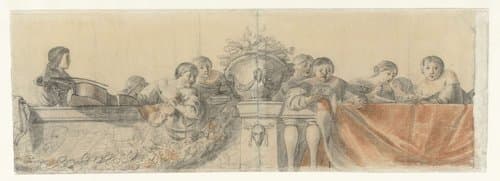
Ontwerpen voor wandschilderingen in kasteel Honselaersdijk
1633 - 1638
Medium
paper
Dimensions
208; 600
Rights
Public Domain
About this artwork
hoogte 208 mm (twee aan elkaar geplakte bladen) x breedte 600 mm
Art Historical Context
Cornelis Holsteyn's *Ontwerpen voor wandseringen in kasteel Helaersdijk* (Designs for Wall Paintings in Honselaersdijk Castle), created between 1633 and1638, offers a fascinating glimpse into the grandeur of the Dutch Golden Age. preparatory drawing on paper, measuring just 208 mm high by 600 mm wide— of two sheets meticulously glued together—serves as a blueprint for lavish wall murals. Holsteyn, a versatile Dutch artist known for his portraits and history paintings, captured panoramic compositions ideal for adorning the expansive interiors of elite residences. Commissioned for Honselaersdijk Castle, the opulent summer palace of stadtholder Frederick Henry, Prince of Orange, and his wife Amalia van Solms, these designs reflect the era's Baroque splendor. Built in the 1620s near Delft, the castle symbolized Dutch prosperity and princely ambition, with its gardens later influencing European landscape design. Holsteyn's work likely envisioned mythological or allegorical scenes, common in such settings, to elevate the space with narrative drama and illusionistic depth. The use of paper underscores the preparatory nature of 17th-century design practices, allowing artists to experiment before committing to costly frescoes or oils. Tragically, the castle was demolished in the 19th century, making these fragile sketches invaluable survivors that preserve a lost legacy of Dutch decorative arts. A testament to meticulous craftsmanship, they invite us to imagine the vibrant walls that once dazzled royal guests.
About the Artist
Cornelis Holsteyn · 1618–1658
Cornelis Holsteyn studied under his father Pieter Holsteyn the Elder. He has often been confused with Cornelis Cornelissen. Holsteyn engraved numerous plates from his own drawings. Comment on works: History; Genre.