
Openwork Belt Fitting
Unknown Artist
7th century (?)
Medium
Copper alloy, "tinned" surface
Dimensions
Overall: 2 13/16 x 1/16 in. (7.2 x 0.2 cm)
Classification
Metalwork-Copper alloy
Culture
Frankish
Department
Medieval Art
Museum
Metropolitan Museum of Art, New York, NY
Credit
Gift of J. Pierpont Morgan, 1917
Accession Number
17.191.254
Rights
Public Domain
Art Historical Context
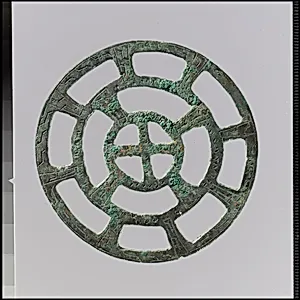
This delicate **Openwork Belt Fitting**, crafted by an unknown Frankish artisan in the 7th century (?), exemplifies the refined metalworking skills of early medieval Europe. Belonging to the Merovingian period, when the Franks dominated much of Gaul (modern France and Germany), such fittings adorned belts that were essential accessories for both men and women, signaling social status and personal style. Donated to the Metropolitan Museum of Art in 1917 by J. Pierpont Morgan, this tiny piece—measuring just 2 13/16 x 1/16 inches—offers a glimpse into the daily lives of Frankish elites amid the transition from late antiquity to the Middle Ages. Fashioned from copper alloy with a "tinned" surface—a technique that applied a thin layer of tin to mimic silver's luster and enhance durability—the fitting features openwork, where intricate patterns are pierced through the metal to create airy, decorative motifs. This labor-intensive method highlights the technical prowess of Frankish craftsmen, who blended Roman influences with emerging Germanic aesthetics. Though small, its preservation reveals how everyday objects became canvases for artistry. In the Medieval Art department, this artifact underscores the cultural vibrancy of Frankish society, where metalwork bridged utility and ornamentation. Visitors can appreciate how such fittings connected wearers to broader networks of trade and innovation across post-Roman Europe.