
Opgegraven deel van een Romeins reliëf, een ornament en een vaas
1843
Medium
lithography
Dimensions
286; 220
Rights
Public Domain
About this artwork
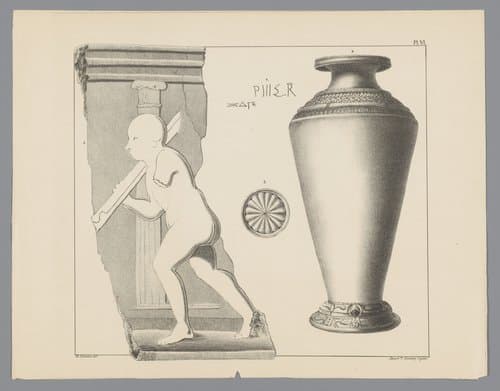
Op het reliëf, mogelijk onderdeel van een fries, is een figuur afgebeeld. De lopende man draagt een balk over zijn schouder. In het midden twee inscripties. Genummerd rechtsboven: Pl. VI.
Art Historical Context
In 1843, Dutch artist Tiemen Hiberg created this delicate lithography, titled *Opgegraven deel van Romeins reliëf een ornament en een vaas* ("Excavated Part of Roman Relief, an Ornament, and a Vase"). just 220 x 286 mm and marked "Pl. VI" in the upper right, it faithfully reproduces an ancient Roman stone fragment, likely from a frieze The central scene captures a striding male figure bearing a heavy beam across his shoulders, evoking the laborious world of Roman construction or mythology. Flanking it are two inscriptions and additional ornamental elements, hinting at the relief's original decorative purpose. Lithography, Hooiberg's chosen medium, was revolutionary in the 19th century for its precision in replicating archaeological finds. This technique allowed detailed textures—like the stone's chisel marks and the figure's muscular strain—to be transferred directly from drawings, making antiquities accessible to scholars and enthusiasts amid Europe's Romantic fascination with classical ruins. Discovered through excavation, the relief offers a glimpse into Roman daily life or architectural grandeur, preserved for posterity. As Plate VI in what was likely a series, this print underscores the era's archaeological zeal, bridging ancient Rome with modern curiosity. Visitors, imagine the thrill of unearthing such a relic—Hooiberg's work invites us to ponder the hands that carved it millennia ago.