
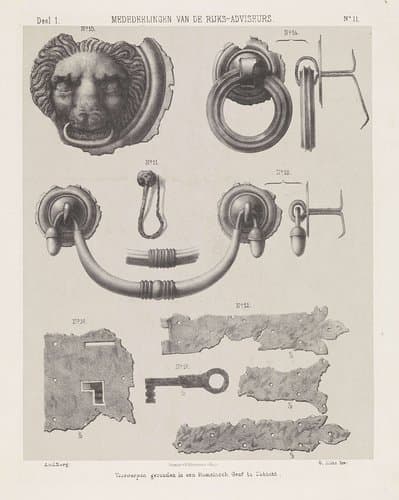
Opgegraven Romeinse handvatten, deurknoppen en sloten
1862 - 1887
Medium
lithography
Dimensions
370; 270
Rights
Public Domain
About this artwork
lithografie
Art Historical Context
"Opgegraven Rome handvatten, deuroppen en sloten (Excavated Roman, Door Knobs, Locks), created by Dutch artist Andries van den between 1862 and1887, is a lithograph measuring 370mm high by 270mm wide. This print a collection of ancient Roman artifacts unearthed during 19th-century excavations, in the Netherlands where Roman ruins abound, such as those in Nijmegen or along the Rhine frontier. Van den Berg's reflects the era's growing fascination with classical antiquity, as archaeologists and artists collaborated to document and preserve these everyday objects from Rome's provincial outposts. Lithography, the medium here, was revolutionary in the mid-1800s for its ability to reproduce fine details with crayon-like precision on stone plates, making intricate archaeological illustrations accessible to scholars and the public alike. Unlike engravings, it allowed for subtle textures and tones, vividly conveying the bronze patina and ornate designs of these functional items—handles shaped like lions' heads or floral motifs, door knobs with imperial motifs, and sturdy locks emblematic of Roman engineering. This piece holds cultural significance as a bridge between antiquity and the modern age, showcasing how 19th-century Europe reclaimed its Roman heritage amid nationalism and scientific curiosity. Visitors can appreciate not just the artistry, but a window into daily Roman life, preserved through Van den Berg's skilled hand.
About the Artist
Andries van den Berg · 1852–1944
Comment on works: graphic artist; still lives; genre