
Ophelia
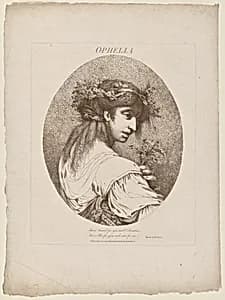
Medium
etching on wove paper
Dimensions
plate: 40.2 × 32.7 cm (15 13/16 × 12 7/8 in.) sheet: 59 × 43.6 cm (23 1/4 × 17 3/16 in.)
Classification
Department
CG-E
Museum
National Gallery of Art, Washington, D.C.
Credit
Gift of Thomas Vogler in memory of his brother Donald J. Vogler
Accession Number
2017.53.98
Rights
Public Domain
Art Historical Context
John Hamilton Mortimer's *Ophelia* (1775) is a captivating etching that draws from Shakespeare's tragedy *Hamlet*, depicting the ill-fated heroine in her moment of drowning—a poignant symbol of madness and melancholy. Created during the late 18th, when Shakespearean themes surged in popularity amid Britain's growing fascination with dramatic literature and the emerging Gothic sensibility, Mortimer's work reflects the era's blend of Rococo elegance and proto-Romantic intensity. As a leading British artist known for his expressive history paintings and prints, Mortimer infused his figures with elongated, theatrical poses, evoking deep emotion and narrative depth. This print, executed as an etching on wove paper—a smooth, modern substrate ideal for capturing fine details—showcases Mortimer's mastery of the intaglio technique. Acid etched into a metal plate allowed for intricate lines that convey texture, from Ophelia's flowing garments to the watery ripples, making it a reproducible yet intimate artwork. Measuring 40.2 × 32.7 cm on the plate, it exemplifies the scale suited for collector's cabinets. Housed in the National Gallery of Art thanks to a thoughtful gift, *Ophelia* highlights Mortimer's underappreciated role in bridging 18th-century printmaking with literary inspiration, inviting visitors to ponder themes of beauty, loss, and the human psyche that resonate across centuries.
About the Artist
John Hamilton Mortimer · 1740–1779
Comment on works: History; Portraits; Genre