
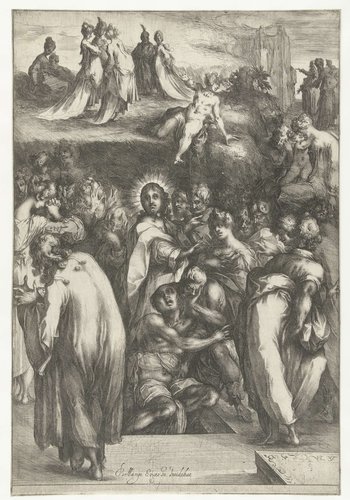
Opwekking van Lazarus
1602 - 1616
Medium
engraving
Dimensions
458; 311
Rights
Public Domain
About this artwork
verzamelaarsmerk, verso linksonder, gestempeld: Lugt 240
Art Historical Context
Jacques Bellange's *Opwekking van Lazarus (The Raising of Lazarus), created between 1602 and1616, vividly captures the biblical miracle from the Gospel of John, where Jesus resurrects his friend Lazarus before a crowd of astonished onlookers. As a leading engraver from the Duchy of Lorraine in northeastern France, Bellange exemplified the Mannerist style of the early 17th century blending intricate line work with dramatic poses and emotional intensity. His prints, produced during a time of religious fervor amid the Counter-Reformation, served as devotional aids and collector's items, bridging art and spirituality for a growing market of print enthusiasts. This etching measures an impressive 458 mm high by 311 mm wide—generous dimensions for an engraving, allowing Bellange to showcase his virtuoso technique. Using a burin to incise fine lines into a copper plate, he achieved rich tonal contrasts through cross-hatching and stippling, evoking the miracle's supernatural light and the figures' awe-struck expressions. Engravings like this were revolutionary for their reproducibility, disseminating sophisticated art beyond elite patrons. On the verso, lower left, bears a collector's mark stamped Lugt 240, a testament to its esteemed provenance in historic European collections. This rare work invites visitors to marvel at Bellange's mastery, a cornerstone of Northern Mannerism preserved for modern contemplation.
About the Artist
Jacques Bellange · 1570–1616
Jacques Bellange (c. 1575–1616) was a French artist and printmaker active in the independent Duchy of Lorraine, now part of France. Believed to have been born in the Bassigny region south of Nancy, his early life and training remain sparsely documented, with no records of specific teachers or mentors. He first appears in historical records in 1595 at La Mothe, where he took on an apprentice, sugge...