
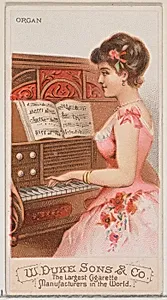
Organ, from the Musical Instruments series (N82) for Duke brand cigarettes
Medium
Commercial color lithograph
Dimensions
Sheet: 2 3/4 x 1 1/2 in. (7 x 3.8 cm)
Classification
Prints|Ephemera
Department
Drawings and Prints
Museum
Metropolitan Museum of Art, New York, NY
Credit
The Jefferson R. Burdick Collection, Gift of Jefferson R. Burdick
Accession Number
63.350.204.82.35
Rights
Public Domain
Tags
Art Historical Context
This charming 1888 color lithograph belongs to Duke brand cigarettes’Musical Instruments” seriesN82), a of small collectible cards into cigarette packs to encourage brand loyalty. Measuring just 2¾ by 1½ inches, the print depicts an organ and female musicians, reflecting the era’s growing fascination with domestic music-making and the expanding presence of women in public musical life. Produced by W. Duke, Sons & Co. in partnership with lithographers Schumacher & Ettlinger, the card exemplifies late-nineteenth-century commercial printing at its most colorful and accessible. Color lithography allowed manufacturers to create bright, detailed images inexpensively, turning everyday tobacco packaging into miniature works of art. Collectors eagerly traded these cards, which often featured educational themes such as musical instruments, thereby blending advertising with light instruction. Today the sheet forms part of the Metropolitan Museum’s Burdick Collection, preserving a delightful fragment of Victorian popular culture that once traveled in a smoker’s pocket.
About the Artist
W. Duke, Sons & Co.|Schumacher & Ettlinger · 1870–1920
**W. Duke, Sons & Co.: Pioneers of Chromolithographic Trade Card Art** W. Duke, Sons & Co., an American tobacco manufacturer, emerged from the entrepreneurial vision of Washington Duke (1820–1905) and his sons in Durham, North Carolina. After the Civil War, Washington abandoned farming in 1874 to join his eldest son, Brodie L. Duke, in the burgeoning tobacco trade, establishing a factory that for...