
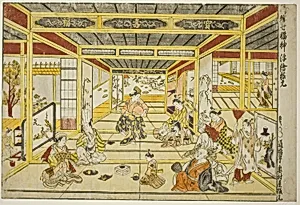
Original Perspective Picture of the Fashionable Seven Gods of Good Fortune (Furyu shichi fukujin uki-e kongen)
1740s
Medium
Hand-colored woodblock print; o-oban, beni-e
Dimensions
29.7 × 44.5 cm (11 3/4 × 17 1/2 in.)
Classification
woodblock print
Department
Arts of Asia
Museum
Art Institute of Chicago
Accession Number
19493
Rights
Public Domain
Art Historical Context
In the bustling world of 18th-century Edo (modern Tokyo), Okumura Masanobu's *Original Perspective Picture of theable Seven Gods of Good* (c. 1740s) captures the playful spirit of ukiyo-e, the "pictures of the floating world." hand-colored woodblock print reimagines Japan's beloved Seven Lucky Gods—Ebisu, Daikoku, Bishamonten, Benzaiten, Fukurokuju, Jurojin, and Hotei—as stylish, contemporary figures amid a dynamic scene. Masanobu, a pioneering printmaker, infuses the composition with *fūryū* (elegant fashion), blending divine benevolence with urban flair to appeal to everyday viewers seeking good fortune and amusement. The artwork's technical brilliance lies in its *uki-e* ("floating picture") style, Masanobu's innovative adoption of Western linear perspective to create a startling sense of depth on a flat surface—a rarity in Japanese art at the time. Printed in *beni-e* format (using crimson pigments for vivid reds, often hand-tinted), on a large *ōban* sheet (29.7 × 44.5 cm), it exemplifies early color woodblock techniques before full polychrome printing emerged. Housed in the Art Institute of Chicago's Arts of Asia collection, this print highlights Masanobu's role in democratizing art through affordable, mass-produced images. Culturally, the Seven Gods symbolized prosperity and protection, often carried in portable shrines during New Year's treasure ship processions. Masanobu's trendy twist reflects Edo's thriving merchant culture, making sacred icons accessible and chic for the masses. A delightful window into Japan's vibrant print tradition!
About the Artist
Okumura Masanobu · 1686–1764
Japanese, 1686–1764