
Ornament
Unknown Artist
19th century
Medium
Needle lace
Dimensions
H. 3 x W. 2 3/4 inches (7.6 x 7.0 cm)
Classification
Textiles-Laces
Culture
Italian, Venice
Department
European Sculpture and Decorative Arts
Museum
Metropolitan Museum of Art, New York, NY
Credit
Museum Accession
Accession Number
X.285
Rights
Public Domain
Tags
Art Historical Context
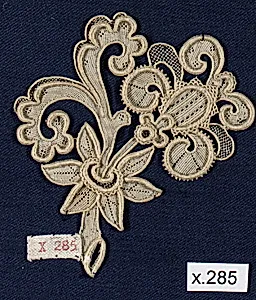
This delicate **Ornament** from 19th-century Venice exemplifies the exquisite needle lace tradition of Renaissance Italy, which flourished in the lagoon city as a pinnacle of decorative arts. Crafted by an unknown artist, this small piece—measuring just 3 x 2¾ inches (7.6 x 7 cm)—likely served as a personal accessory, such as a collar insert, cuff, or jewelry element, adorned with intricate floral motifs that evoke the natural beauty of Venetian gardens and canals. Needle lace, or *punto in aria* ("point in air"), is a labor-intensive technique where threads are individually stitched and knotted in mid-air on a paper pattern, creating a freeform, sculptural fabric without a woven ground. This method allowed Venetian lacemakers to achieve unparalleled transparency and three-dimensionality, making lace a status symbol for Europe's elite. By the 19th century, Venice remained a lace-making hub, though industrial competition began to eclipse handmade works. Housed in the Metropolitan Museum of Art's European Sculpture and Decorative Arts Department, this ornament highlights Italy's enduring textile legacy. Its floral design not only showcases technical virtuosity but also reflects the era's Romantic fascination with nature, inviting visitors to appreciate the unseen hours of skilled craftsmanship in every petal and stem.