
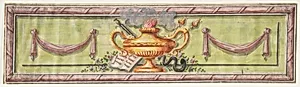
Ornamental Panel with Flaming Lamps and Sheet Music
19th century
Medium
Watercolor on vellum
Dimensions
sheet: 4 x 14 in. (10.2 x 35.6 cm)
Classification
Drawings
Department
Drawings and Prints
Museum
Metropolitan Museum of Art, New York, NY
Credit
Gift of Harry G. Friedman, 1962
Accession Number
62.635.199
Rights
Public Domain
Tags
Art Historical Context
This delicate *Ornamental Panel with Flaming Lamps and Sheet*, created by an anonymous French artist in the 19th, exemplifies the ornate decorative arts of its era. Rendered in watercolor on vellum—a translucent animal skin prized for its smooth surface and ability to capture luminous, jewel-like colors—the piece measures a slender 4 x 14 inches (10.2 x 35.6 cm). This medium allowed for intricate detailing, evoking the precision of illuminated manuscripts while adapting to modern tastes. The composition features flaming lamps, swirling sheet music, and serpentine motifs, blending symbols of enlightenment, melody, and perhaps mythological allure. In 19th-century France, such ornamental panels often adorned private albums, furniture, or walls, reflecting a revival of Rococo exuberance amid Romantic interests in fantasy and nature. Snakes, intertwined with music, hint at cultural associations with harmony, temptation, or the classical muses, adding layers of intrigue to this intimate drawing. Now housed in the Metropolitan Museum of Art's Drawings and Prints department, thanks to a 1962 gift from Harry G. Friedman, it invites visitors to marvel at its fine craftsmanship and the anonymous artist's skill in weaving everyday elegance with whimsical symbolism.
About the Artist
Anonymous, French, 19th century · 1800–1900
**Anonymous, French, 19th Century (ca. 1800–1900)** The artist cataloged as Anonymous, French, 19th century embodies the enigmatic yet essential contributions of unidentified creators to France's vibrant 19th-century art world. Active roughly between 1800 and 1900, this figure—or potentially collective workshop—produced a diverse array of works amid the nation's transition from Neoclassicism thro...