
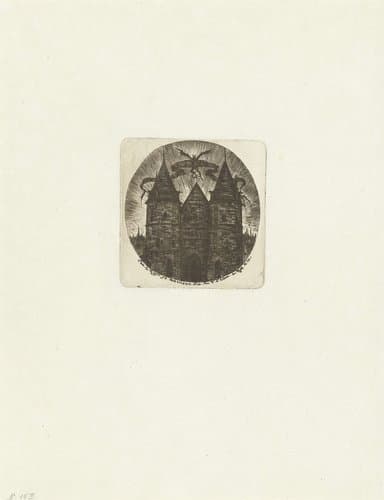
Oud poortgebouw van Palais de Justice in Parijs
1854
Medium
etching
Dimensions
294; 87; 226; 85
Rights
Public Domain
About this artwork
height 294 mm x width 226 mm
Art Historical Context
Step into the shadowy allure of 19th-century Paris with Meryon's *Oud poortgebouw van Palais de Justice in Pari* (1854), a masterful etching capturing the ancient gateway of the Palais de Justice. Measuring a intimate 87 mm high by 85 mm wide—likely the plate mark on a larger sheet of 294 mm x 226 mm—this print preserves a Gothic relic amid the bustling medieval heart of the Île de la Cité, just before Baron Haussmann's sweeping renovations would erase such structures. Meryon, a pioneering French etcher (1821–1868), elevated etching from reproductive technique to poetic art in his *Eaux-Fortes sur Paris* series. Here, his virtuoso use of fine, burr-rich lines conjures dramatic contrasts: intricate stone tracery, weathered textures, and brooding skies that evoke Romantic melancholy. No mere topography, it's a lament for vanishing architecture, blending precision with atmospheric depth. This tiny gem holds cultural weight as a time capsule of pre-modern Paris, cherished by collectors for Meryon's visionary fusion of realism and mood. A testament to etching's power, it invites us to mourn the old city's ghosts while marveling at enduring artistry.
About the Artist
Charles Meryon · 1821–1868
Charles Meryon, born on November 23, 1821, in Paris, was the illegitimate son of English physician Dr. Charles Lewis Meryon and dancer Pierre-Narcisse Chaspoux (stage name Narcisse Gentil) at the Paris Opéra. His half-sister Fanny, from his mother's prior relationship with Viscount Lowther, remained in contact after their mother's death in 1838. Raised partly outside Paris before attending Pension...