
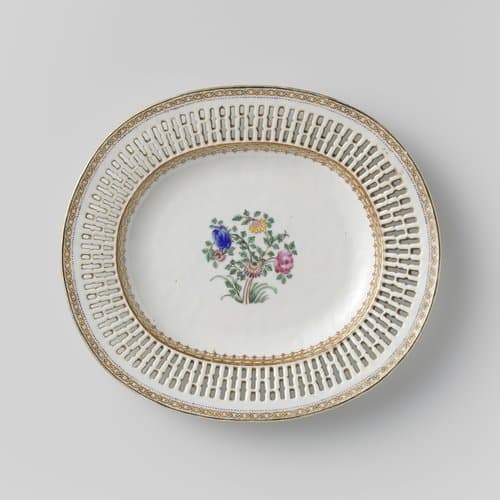
Ovaal bord met bloeiende planten, decoratieve banden en een opengewerkte rand
ca. 1775 - ca. 1799
Medium
turning
Dimensions
23.7; 13; 21; 3.1; 10.6
Rights
Public Domain
About this artwork
rand: lengte 23,7 cm x breedte 21 cm
Art Historical Context
This delicate oval plate, titled *Ovaal bord met bloeiende planten, decoratieve banden en eengewerkte rand*, exemplifies the refined craftsmanship of late 18th-century European decorative arts. Created anonymously around 1775–1799, it measures just 3.1 cm high by 23.7 cm long and 21 cm wide, making it a petite yet intricate tabletop ornament. The design features blooming plants, elegant decorative bands, and a pierced openwork edge, showcasing the artist's skill in capturing natural motifs amid geometric elegance. Crafted through "turning"—a lathe-based technique that spins wood (or similar material) to carve symmetrical forms—this piece highlights a specialized method popular in Northern European workshops during the Rococo-to-Neoclassical transition. The openwork rand (edge), precisely 23.7 cm by 21 cm, required masterful precision to create airy, lace-like patterns without compromising structural integrity, a testament to anonymous artisans' ingenuity. In its era, such objects graced bourgeois homes, blending functionality with ornamentation to reflect Enlightenment-era appreciation for nature and technical virtuosity. Today, it invites us to admire the unsung heroes of decorative history, where everyday materials bloomed into art.
About the Artist
anonymous
In the vast tapestry of art history, "Anonymous" stands not as a singular individual but as a collective designation for countless unidentified creators whose works have endured across millennia. These artists, spanning prehistoric cave painters to medieval illuminators and folk craftsmen, produced the foundational layers of human visual culture. Prior to the Renaissance, when individual fame emer...