
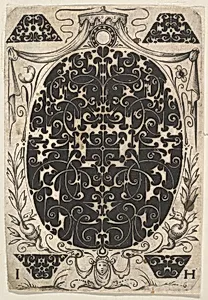
Oval Pendant Decorated with Schweifwerk, Surrounded by Smaller Motifs and Crowned by a Baldachin
ca. 1614–19
Medium
Blackwork and engraving
Dimensions
Sheet (Trimmed): 4 1/16 × 2 13/16 in. (10.3 × 7.1 cm)
Classification
Prints|Ornament & Architecture
Department
Drawings and Prints
Museum
Metropolitan Museum of Art, New York, NY
Credit
Harris Brisbane Dick Fund, 1939
Accession Number
24.100.1
Rights
Public Domain
Tags
Art Historical Context
This delicate oval pendant design, created around 1614–19 by Jacques Hurtu and engraved by Pierre Firens I, exemplifies the refined ornament prints that flourished in early seventeenth-century Europe. Rendered in blackwork and engraving—a technique prized for its crisp, dense lines that mimic the precision of metalwork—the print served as a portable pattern for goldsmiths and jewelers. Its compact size, just over four inches tall, made it easy to circulate among workshops from Paris to Antwerp and beyond. The composition features swirling Schweifwerk, a dynamic scrollwork style with flowing, tail-like forms that reflect the transition from Mannerist complexity to emerging Baroque elegance. Surrounded by smaller ornamental motifs and topped by a graceful baldachin, the pendant design blends architectural grandeur with wearable luxury. Such prints played a vital cultural role, helping standardize decorative tastes across borders while allowing artisans to adapt the motifs to different materials and clients. Today, this sheet in the Metropolitan Museum’s collection offers a fascinating glimpse into how printed designs shaped the jewelry and decorative arts of the period, preserving ephemeral fashions that might otherwise have been lost.