
Oval-shaped Tweezers
Probably 1000–1400
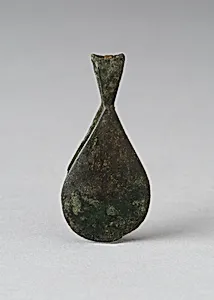
Medium
Copper alloy
Dimensions
H.: 3.2 cm (1 1/4 in.)
Classification
metal
Department
Arts of the Americas
Museum
Art Institute of Chicago
Accession Number
126592
Rights
Public Domain
Art Historical Context
Crafted by the Chimú people of Peru's north coast, these oval-shaped tweezers exemplify the sophisticated metalworking of a culture that thrived from around 900 to 1470 CE. Dating to roughly 1000–1400, this petite copper alloy tool measures just 3.2 cm in height, highlighting the Chimú's mastery in producing finely detailed objects from humble materials. Displayed in the Art Institute of Chicago's Arts of the department, it reflects everyday functionality elevated to artistic precision. The Chimú, who built the vast adobe city of Chan Chan, were renowned for their advanced metallurgy, often alloying copper with gold or silver for durability and luster. These tweezers likely served practical purposes like grooming or removing thorns, but their elegant oval form and smooth finish suggest aesthetic intent, blending utility with craft. Such items were common in Chimú society, underscoring a worldview where even tools embodied cultural refinement. This artifact offers a window into pre-Columbian innovation, just before the Inca conquest around 1470. Its survival speaks to the enduring legacy of Chimú artisans, whose techniques influenced Andean metal traditions for centuries.
About the Artist
Chimú
The Chimú, a preeminent pre-Columbian culture of Peru's northern coast, flourished from approximately 900 to 1470 CE as the Kingdom of Chimor, emerging in the wake of the Moche civilization's decline and incorporating influences from the Sican, Wari, and Cajamarca cultures. Centered in the vast adobe metropolis of Chan Chan—the largest city in the Americas before the Inca, housing up to 60,000 peo...